The Silent Damage of Indisciplined Parenting
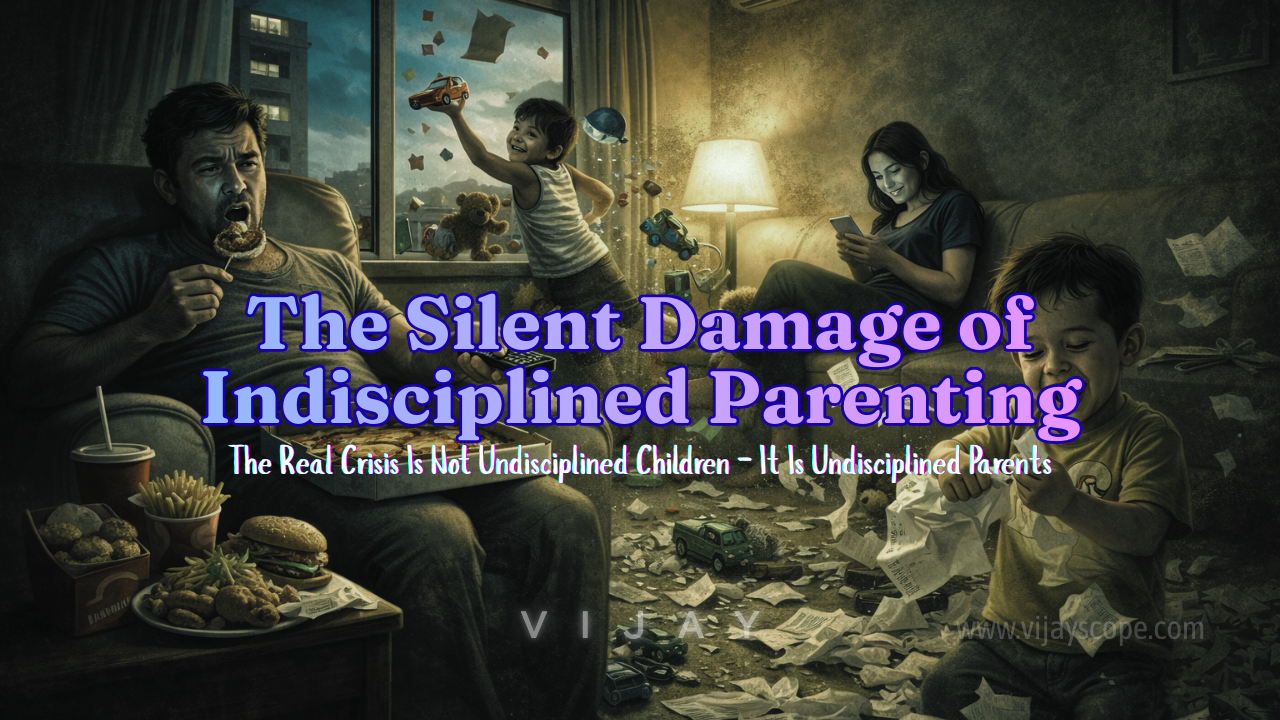
The Real Crisis Is Not Undisciplined Children — It Is Undisciplined Parents
We keep asking what is wrong with children today. We complain they are impatient, rude, distracted, entitled, emotionally fragile, and sometimes even aggressive. We blame phones, social media, schools, peer pressure, and “this generation.” But we rarely have the courage to look at the most obvious source of influence: us.
Children don’t become what we instruct them to become. They become what they repeatedly observe. And today, many children are observing something dangerous: parents normalising wrong behaviour and calling it smartness, support, or modern parenting.
The School Event: When Parents Ruin the Lesson Before It Begins
Recently, I attended my kids’ sports day and annual day. The school had clearly communicated rules: photos and videos would be shared officially, parents should not crowd near the stage, and students would not be handed over until the national anthem was sung. Simple, respectful instructions meant to maintain dignity and order.
Yet many parents behaved as if the rules were meant for someone else.
Even after being told that recordings would be shared, parents rushed toward the stage with phones. They blocked the view of other parents and children. They disturbed security and volunteers. They created chaos near the performance area. The irony is painful — in a program meant to teach children discipline, adults publicly demonstrated indiscipline.
Worse, some parents kept talking loudly through performances. Some passed comments about other children’s mistakes. Some laughed, compared, judged, and mocked — all in front of kids. Inside a school campus — a place we claim is a temple of wisdom — adults behaved as if basic civility was optional. What are we teaching children when we ridicule another child who is trying? That empathy doesn’t matter? That public humiliation is entertainment?
Then there was the national anthem instruction. The school clearly said students would not be handed over until the anthem was completed. Still, some parents went to pick up their kids immediately after their child’s medal or performance was done. Think about the message this sends: “Once I’m done, the rest doesn’t matter.” If every parent behaves like that, who stays back to clap for other kids? Who appreciates the late performers? Who respects the collective nature of a school event? Children learn not just from applause — they learn from the absence of it too.
I also noticed parents reserving front seats with kerchiefs, water bottles, and handbags for late-arriving friends while many parents and elders stood behind struggling for space. Some parents even called their children from the audience when the kids were on stage, distracting them mid-dance. This isn’t “enthusiasm.” It’s lack of control. And it becomes a live demonstration for children that rules can be bypassed, courtesy can be ignored, and the community can be inconvenienced for personal comfort.
On top of that, I have also noticed some parents attending in clothing that is inappropriate for a school setting. This is not about policing fashion — it’s about understanding space and context. A school is not a nightclub, not a private party. Children are present. Teachers are present. A certain standard of dignity is expected. Situational awareness is part of discipline. When adults don’t practise it, children learn that boundaries don’t exist.
Teaching Children That Wrong Is Smart
Outside school events, the indiscipline continues on roads — and it is terrifying. I have seen parents drive in the wrong direction and act like a hero in front of their children. I have seen them jump signals, cut lanes, and justify it with casual confidence — as though breaking rules is intelligence.
Do these parents think their kids won’t notice?
Do they think the child’s conscience won’t question it?
Children may not confront you today, but they store it. They learn that:
rules are optional,
ethics are flexible,
and being “smart” means getting away with wrong.
And later, when those children break rules and endanger others, parents act shocked — as if it came from nowhere.
The Double-Life Parent: Lecturing Discipline, Living Indiscipline
Some parents speak endlessly about discipline. They lecture their kids on sports, good sleep, healthy food, focus, and routine. They want their kids to be strong and resilient.
But what do their children actually see?
They see parents doing binge-watching at night and waking up tired. They see late-night parties. They see late-night food cravings and heavy dinners from food courts. They see junk eating as a habit, not an exception. They see no exercise, no fitness routine, no reading, no self-control — just entertainment, malls, cinema, scrolling, and impulse.
They speak about:
The importance of sports.
The value of waking up early.
The need for proper sleep.
The importance of healthy eating.
The benefits of focus and self-control.
But what do children see?
They see parents binge-watching late into the night.
They see midnight food deliveries.
They see weekend after weekend of heavy partying.
They see irregular sleep schedules.
They see constant scrolling.
They see no reading habits.
They see zero commitment to fitness.
They see stress without self-regulation.
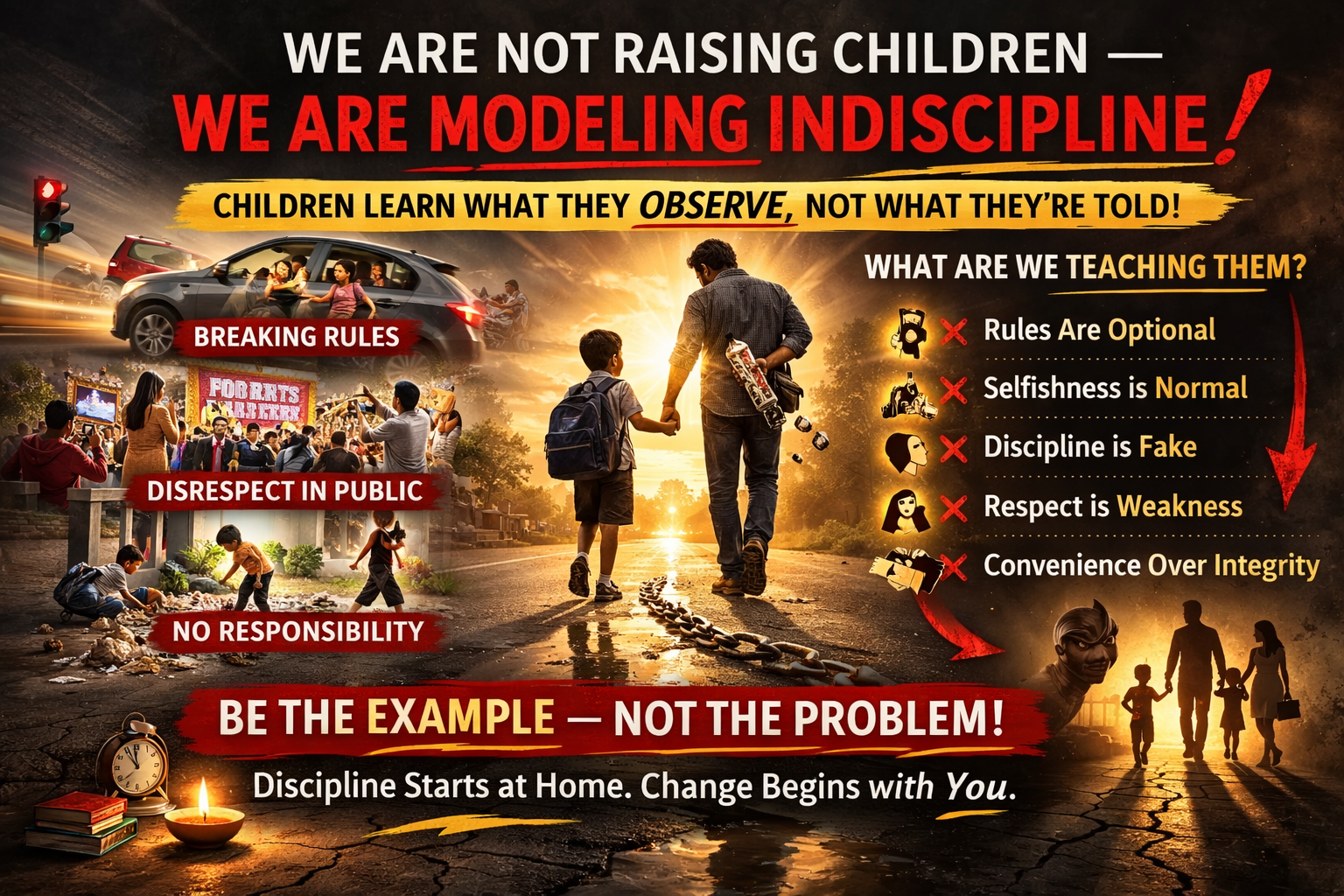
And then, in the morning, they hear:
“Why are you lazy?”
“Why can’t you wake up early?”
“Why don’t you focus?”
What message is the child absorbing?
Not the lecture.
The contradiction.
This is hypocrisy, and children detect hypocrisy faster than adults realize. A child raised in a home where discipline is only spoken — not lived — becomes confused. They either grow up believing discipline is fake, or they grow up believing lying is normal. Both are dangerous.
Apartment Common Areas: The Collapse of Civic Sense
In apartment communities, the damage becomes even more visible. I have seen toddlers and kids throwing food in common areas, sometimes urinating in shared spaces, and parents not bothering to clean it or even acknowledge it. What kind of mindset is that? It’s not “child behaviour” anymore — it’s adult negligence.
No correction.
No cleaning.
No explanation.
If a parent refuses to clean up their child’s mess in a shared space, they are teaching the child:
“Someone else will handle it.”
“This is not your responsibility.”
“You can inconvenience others and walk away.”
Cleanliness is not about status. It is about civic ethics. If a parent cannot bend down and clean what their child dirtied, what humility are they modeling?
What ethical standard are they passing forward?
That is how civic sense dies. And when civic sense dies, discipline becomes impossible.
Stop Calling It Support When It’s Actually Enabling
Many parents think defending their children in public makes them supportive. They think correcting a child in front of others will “hurt their confidence.” So they smile when neighbours complain. They laugh off bullying, vandalism, bad words, rough behaviour, and disrespect.
But that isn’t support.
That is enabling.
Supporting your child does not mean protecting their wrong actions. It means protecting their future by correcting them now. Because if you don’t teach boundaries at home, the world will teach them outside — and the world teaches without love.
As the Tamil proverb says:
"உங்கள் குழந்தையை நீங்கள் திருத்த தவறினால், ஊர் அடித்து திருத்தும்."
If you don’t correct your child, society will — and it will not be gentle.
I have seen parents who talk passionately about raising “strong children” but lose control over the smallest inconvenience.
They shout at waiters.
Argue with security.
Cut queues at events.
Reserve seats unfairly.
Ignore announcements.
Rush to leave before the national anthem because “our part is done.”
And all of this happens in front of their children.
Do they think the child will separate the lecture from the lifestyle?
Children don’t separate.
They integrate.
If they see you disrespecting systems, they will too.
If they see you prioritize yourself over community, they will too.
If they see you break small rules comfortably, they will break bigger ones confidently.
Many parents from the 80s and 90s were raised with structure, boundaries, and consequences. But in an attempt to be “better” or “more modern,” they have removed structure completely.
Now it is:
No firm “no.”
No consistent boundaries.
No consequences for tantrums.
No delayed gratification.
Instead, we see:
Rewarding emotional outbursts.
Giving in at malls.
Buying silence with gadgets.
Avoiding correction to maintain friendship.
That is not progressive parenting.
That is fear-driven parenting.
And fear-driven parenting produces fragile children.
Children who cannot tolerate discomfort.
Children who crumble at rejection.
Children who feel entitled to comfort.
And when the world does not comply, they collapse.
The Hard Conclusion
Let’s stop pretending this is a “child problem.”
This is an adult problem.
When parents break rules casually, children learn indiscipline.
When parents live unhealthy, inconsistent lifestyles, children learn hypocrisy.
When parents normalise selfishness in public spaces, children learn entitlement.
When parents refuse to correct wrong behaviour, children learn arrogance.
Children don’t become undisciplined overnight.
They are trained into it — slowly — by what they see daily.
Children are not becoming weak accidentally.
They are becoming reflections:
Reflections of impulsive lifestyles.
Reflections of civic irresponsibility.
Reflections of moral inconsistency.
Reflections of adult impatience.
If we truly want a better generation, we need to stop delivering lectures and start living examples. Discipline is not about control. It is about self-regulation, responsibility, empathy, and respect — especially when no one is watching.
Because the most powerful parenting happens silently:
in how we drive,
in how we behave in public,
in how we respect rules,
in how we handle inconvenience,
in how we treat others,
in how we live when nobody is clapping.
And right now, too many children are watching adults fail that test.
Before we question children, we must examine ourselves.
Are we disciplined with time?
Are we disciplined with food?
Are we disciplined with money?
Are we disciplined with anger?
Are we disciplined with public behavior?
Are we disciplined with civic responsibility?
Because discipline is not shouting at children.
Discipline is self-regulation.
Discipline is choosing right over convenient.
Discipline is doing what is correct even when no one is watching.
Discipline is living the standards we expect from the next generation.
If we fail at that, we are not raising children.
We are reproducing our indiscipline.
And that is not a child problem.
That is a parent problem.