Ending the Year with the Forest
Kumbakarai to Vellagavi — The Sacred First Day!
“From the place where we rested at the top of Vellagavi, the world below disappeared. Clouds moved beneath our feet, and for a moment, it felt like we weren’t standing on a mountain—but floating inside a dream.”
That moment didn’t arrive suddenly. It was earned—step by step, breath by breath, doubt by doubt. And I want you, as you read this, to walk with me into that moment.
The Beginning
On 31/12/2025, we stood at Kumbakarai Falls. The sound of water crashing against rocks filled the air—raw, untamed, constant. I always pause longer at places like this. Waterfalls remind me that effort doesn’t have to be loud to be powerful.
I turned to her and said,
“Look closely. Water never argues with the rock. It doesn’t rush. It stays, flows, and eventually shapes everything.”
That was how I wanted to step out of 2025—not rushing, not resisting—just flowing forward with intention.
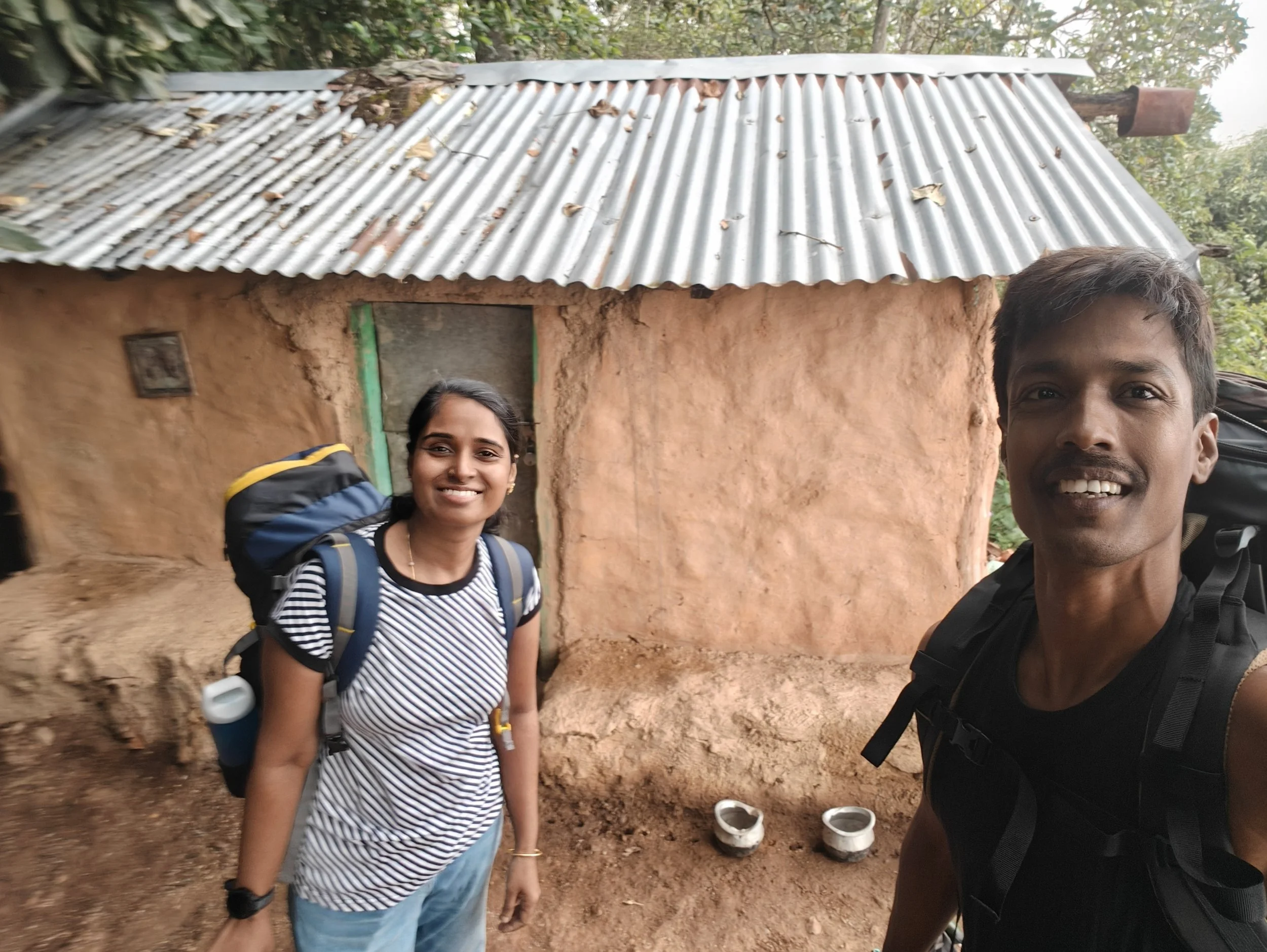
This trek mattered deeply to me. It wasn’t just another route on the map. It was only the second time I was bringing my wife into a terrain this demanding, after the Kullar Caves trek. The last time had been a wake-up call for her—and honestly, for both of us. The wilderness has a way of stripping away assumptions. It doesn’t care about confidence without preparation.
She had realised something crucial back then: fitness in nature isn’t aesthetic—it’s functional.
Preparing Before the Forest Tests You
Ten days before the trek, we slowed life down. No dramatic training plans. No sudden intensity. Just consistency. Every single day, she walked a minimum of 5 km—not casually, but briskly enough to feel her breath.
I’ve always told my wife something very honestly—and sometimes very stubbornly: “Yoga alone won’t build the kind of strength and endurance the mountains demand.”
Yoga is beautiful. It brings flexibility, awareness, and calm. But I’ve seen, through my own training, that the body needs variety—strength to support joints, cardio to sustain long effort, and mindful practices like Tai Chi to conserve energy. That’s how I train. That balance is what allows me to walk long distances without fighting my own body.
She wasn’t fully convinced back then. And honestly, I didn’t push the idea too hard—because some lessons are better taught by experience than explanation.
The Kullar Caves trek became that teacher. The uneven terrain, the constant climbs, the moments where breath became louder than thought—it all made one thing very clear to her. Flexibility alone wasn’t enough. The terrain demanded strength. The distance demanded endurance. And suddenly, variety in training stopped being theory—it became necessity.
This time, before stepping into Vellagavi, she understood it deeply.
So, before the trek, in the evenings, we practiced Tai Chi. Slow, circular movements. Feet rooted. Spine relaxed. Breath leading the body. As part of that preparation, we even walked the 16 km Girivalam at Thiruvannamalai—slow, unhurried, completely at our own pace. I walked with 2 kg ankle weights, not to prove anything, but to quietly build strength and discipline into every step. There was no rush to finish, no numbers to chase—just rhythm, breath, and awareness.
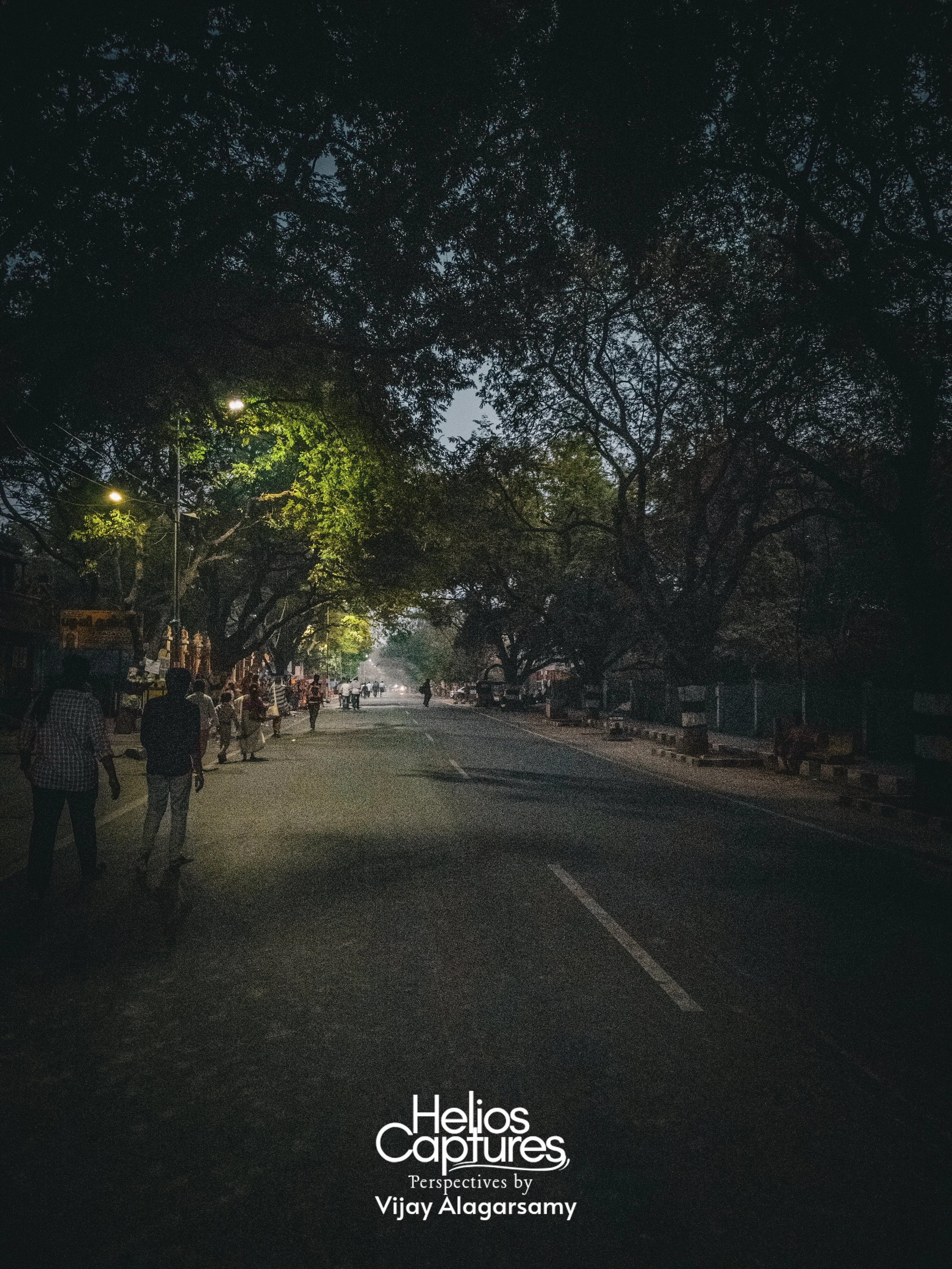
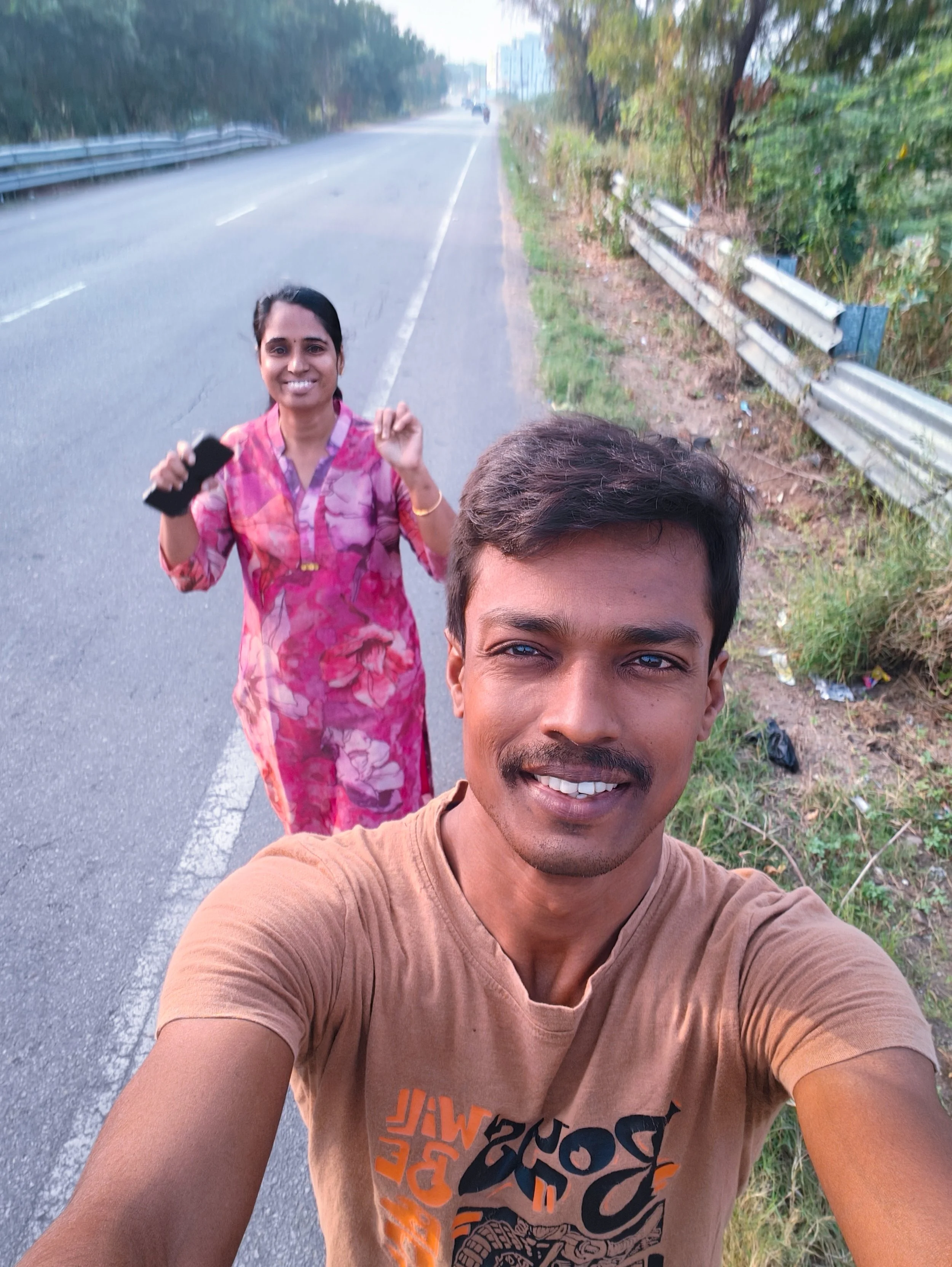
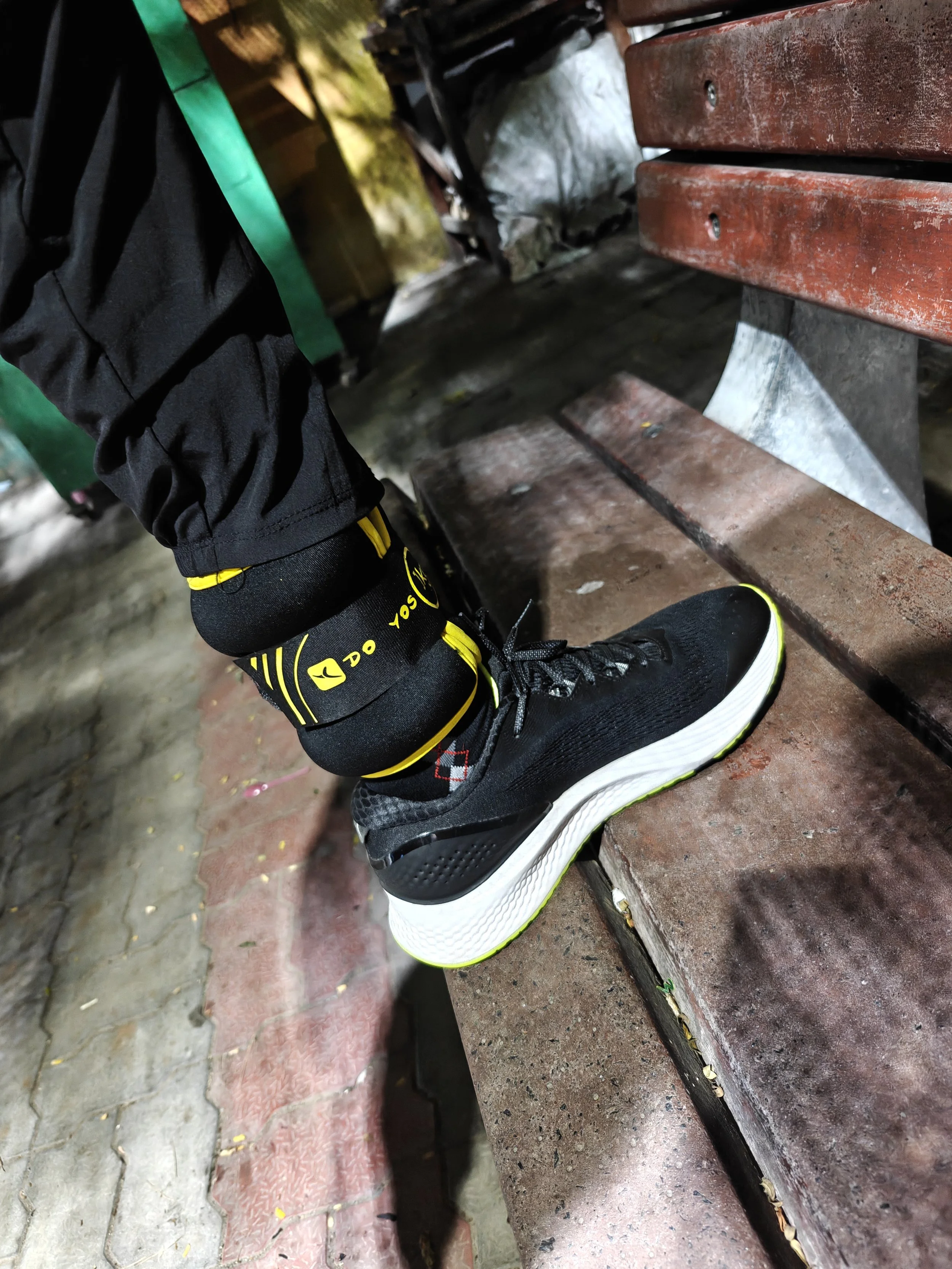
As we walked those long circles around the hill, I told her,
“This isn’t just training for a trek. This is training for life.”
Every kilometre reinforced that belief. We weren’t preparing only for Vellagavi or Kodaikanal. We were preparing our bodies to stay reliable, our minds to stay calm, and our lives to remain mobile and independent for years to come. That walk made it clear—this journey was never about one destination; it was about choosing a way of living.
I kept telling her, “Tai Chi teaches you how not to waste energy. The mountain demands the same thing.”
Gradually, something shifted. Her resting heart rate dropped from 90–110 to a steady 70–85. But more importantly, her fear softened. Her trust—in her body—returned.
I took care of the rest: proper sleeping bags for cold nights, weather jackets that could handle sudden drops in temperature, and carefully planned travel so fatigue didn’t begin before the trek even started. But the most important training was mental.
I reminded her again and again, “You don’t need to impress the mountain. Just be honest with each step.”
Even until the day we were ready to depart, she would occasionally look at me and ask, “Do you think I’ll be able to climb this path without my body giving up?”
Those questions weren’t about fitness. They were about fear—the quiet kind that shows up when the mind starts imagining everything that could go wrong.
I smiled and told her something I deeply believe: “This is mostly a brain game.”
I reminded her that she was ready. That the walking, the strength work, the Tai Chi, the long Girivalam—all of it had already done its job. This trek, I told her, wasn’t just going to test her muscles. It was going to build her mental strength.
I said, “We need to stay aware of the body—listen to our breath, our heart rate, our energy levels. But at the same time, the mind needs to stay tough. Calm, but strong.”
That balance matters in the mountains. Panic wastes energy. Overconfidence invites injury. Awareness and mental resilience—that’s what keeps you moving forward.
By the time we zipped our backpacks and stepped toward the trail, her questions had softened. Not because the doubt disappeared—but because she trusted herself enough to walk alongside it; she wasn’t nervous, she was present.
Before the Forest Opens Its Gates
Our journey toward the mountains actually began much earlier—quietly, in the early hours of the day.
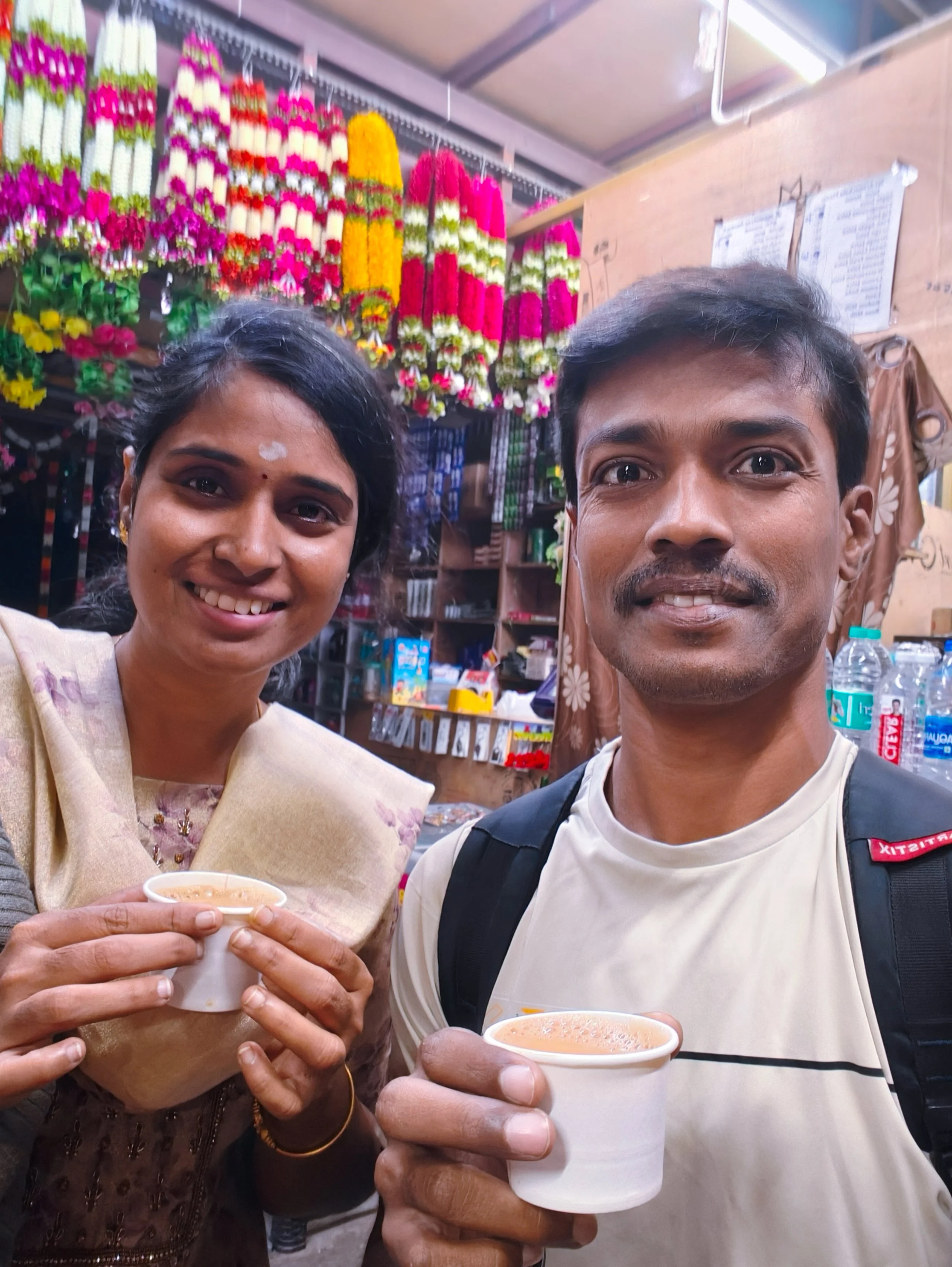
We travelled overnight by bus from Chennai and reached Periyakulam around 5:30 am. The town was still half asleep. The air was cool, the roads were empty, and there was a sense of calm that only exists before a long journey truly begins.
From there, we were picked up by a local friend and taken to his farm to freshen up. By sheer luck—or quiet alignment—the farm was very close to Kumbakarai Falls, the starting point of our trail. My wife rested for a short while and slept till around 7:30 am. I let her be—because rest before a trek is sacred.
During that time, I stepped out and let myself absorb the surroundings. I walked around the farm, took in the smell of wet earth, had tea at a small roadside shop, and spoke with locals who knew these hills far better than any map ever could. I listened carefully, gathered inputs about the Vellagavi trail, the gradient, forest conditions, and how the terrain usually behaves during this season.
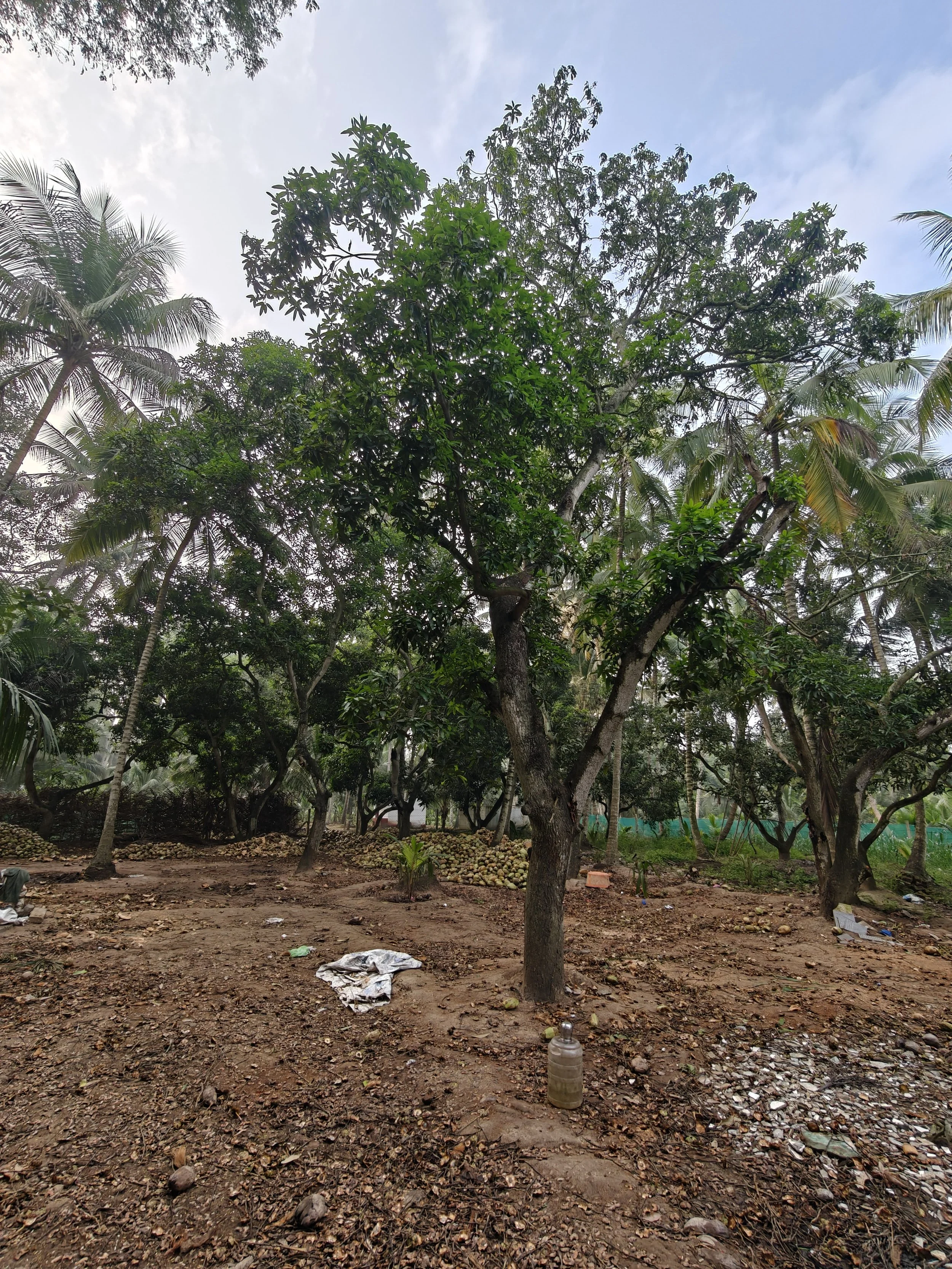
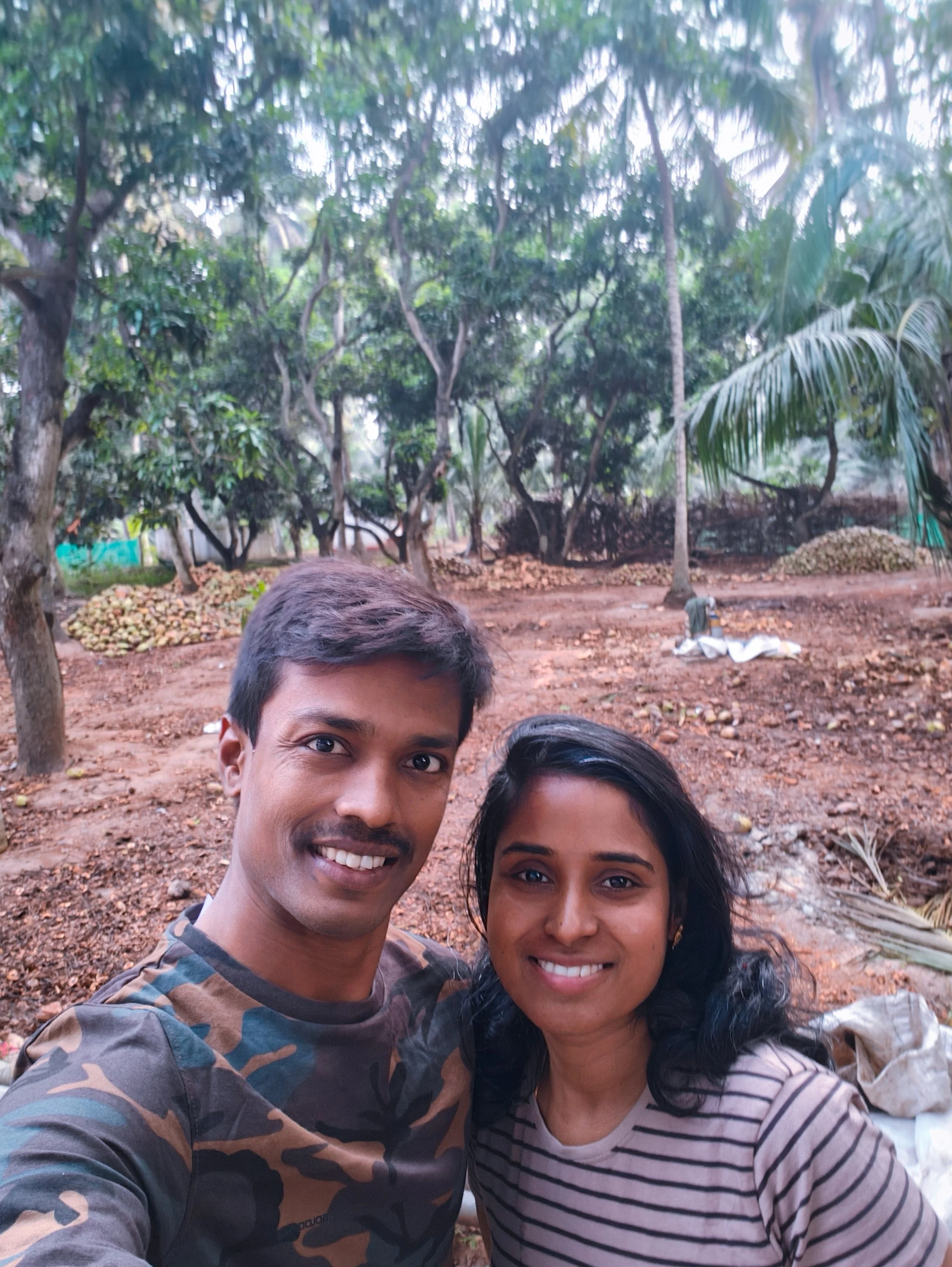
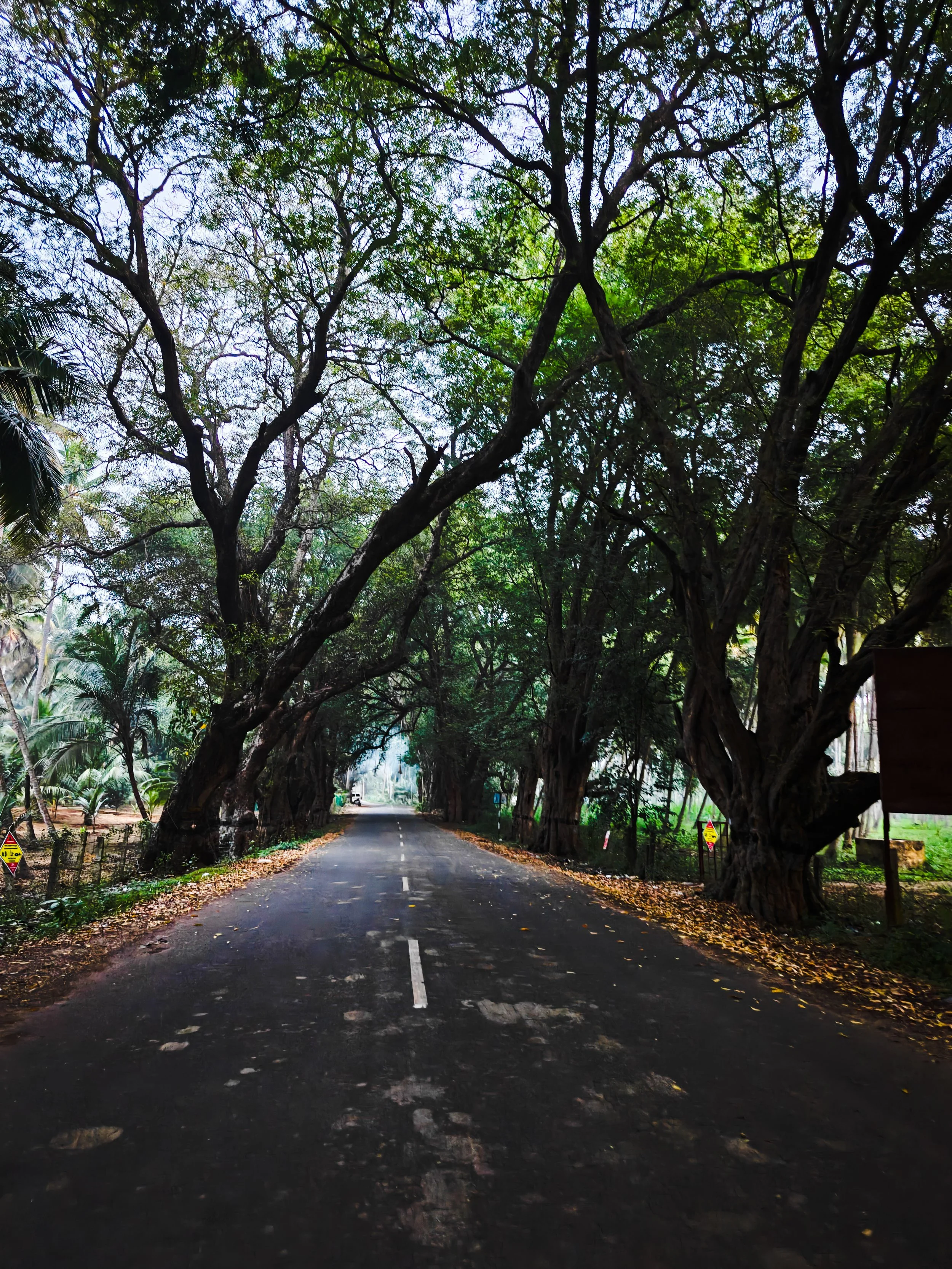
I also connected with the forest officer to double-check permissions and any preparations that needed attention. At the same time, I spoke with Jaga Murugan, who runs the Old Kodai Camping property in Vellagavi village, to ensure everything was aligned for our stay. For me, these conversations are as important as physical preparation. Before you enter the forest, you must make sure you’re entering with awareness and respect.
By 8:00 am, we were ready. On the way to Kumbakarai, our friend picked up breakfast for us—simple, nourishing food that felt just right before a long climb. He dropped us at the forest office, where the formalities were completed without hurry.
From there, we were picked up by Shiva Balan—a man from Vellagavi itself. Someone who doesn’t just guide people through the forest, but belongs to these mountains.
At that moment, the trek stopped being a plan.
The forest was no longer an idea.
It was real—and it was waiting.
Day-1: When the Forest Slowly Pulls You In
Day one was a 9 km walk from Kumbakarai to Vellagavi—not a short distance, but a deeply engaging one. We started around 9:00 am from the Kumbakarai trailhead, settling into a steady rhythm. The trail toward Vellagavi Village doesn’t announce itself. The forest thickens quietly. The ground becomes uneven. Roots twist under your feet like reminders to stay alert.
At first, we talked.
Then we talked less.
Then we stopped altogether.
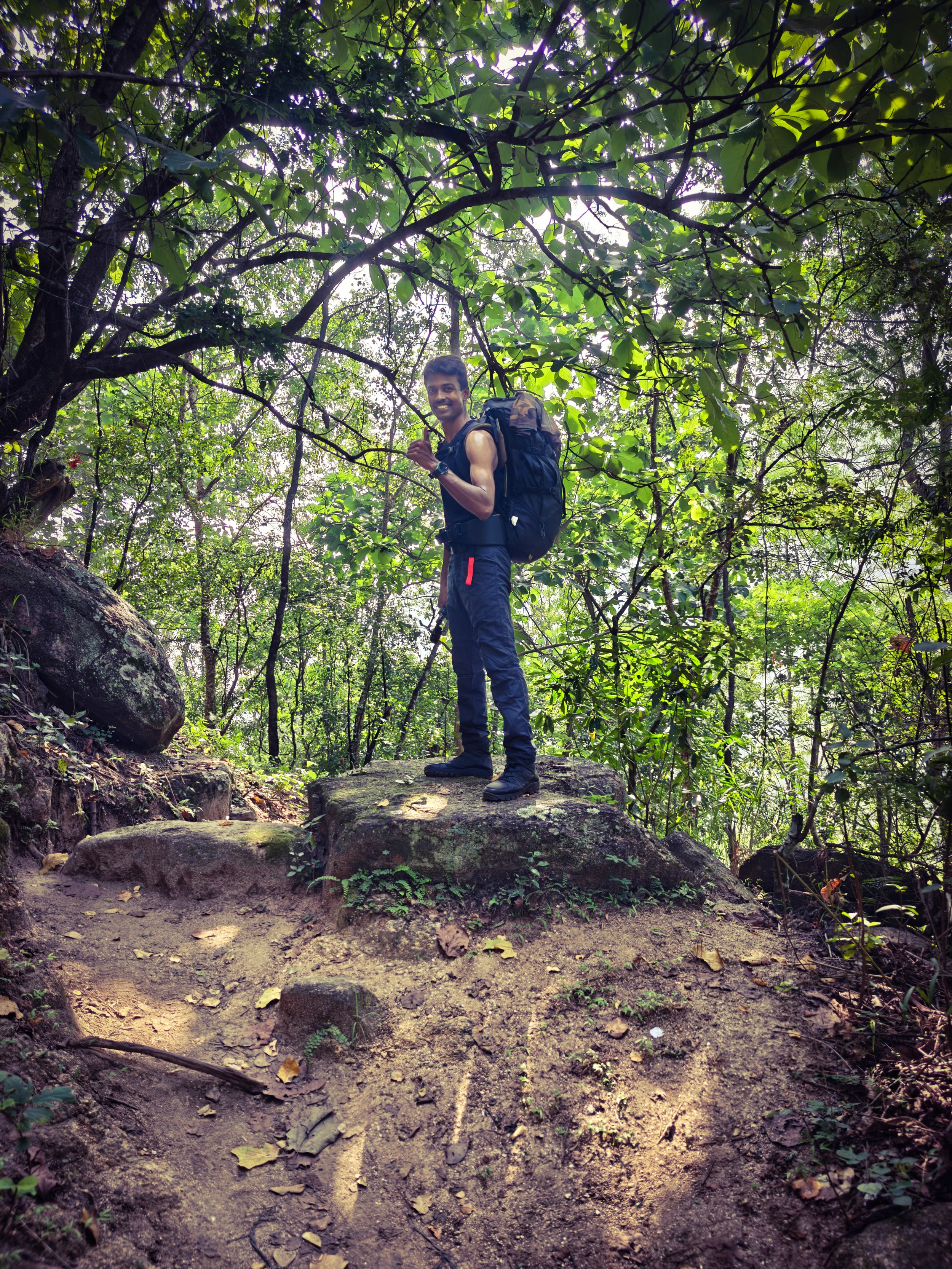
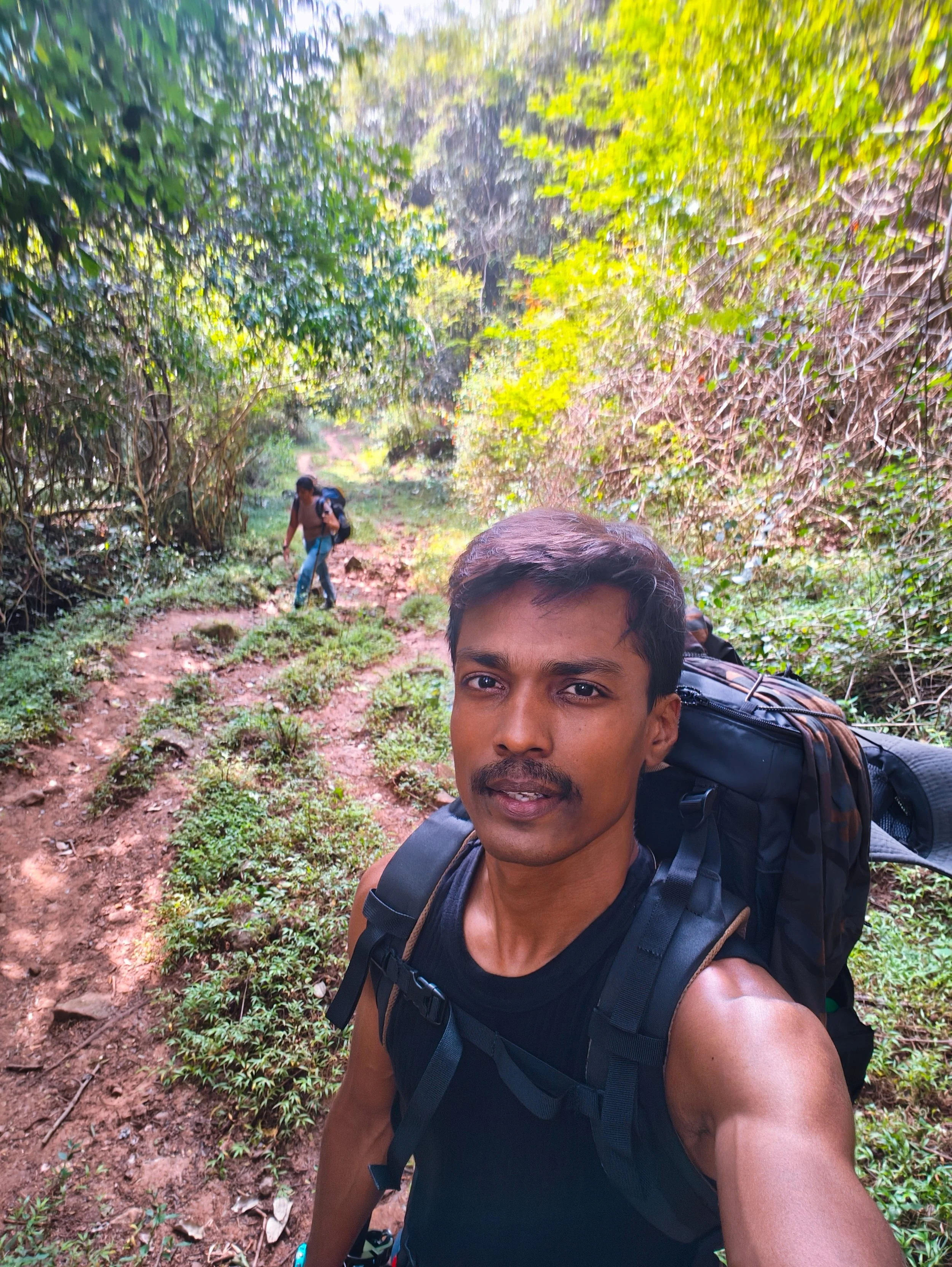
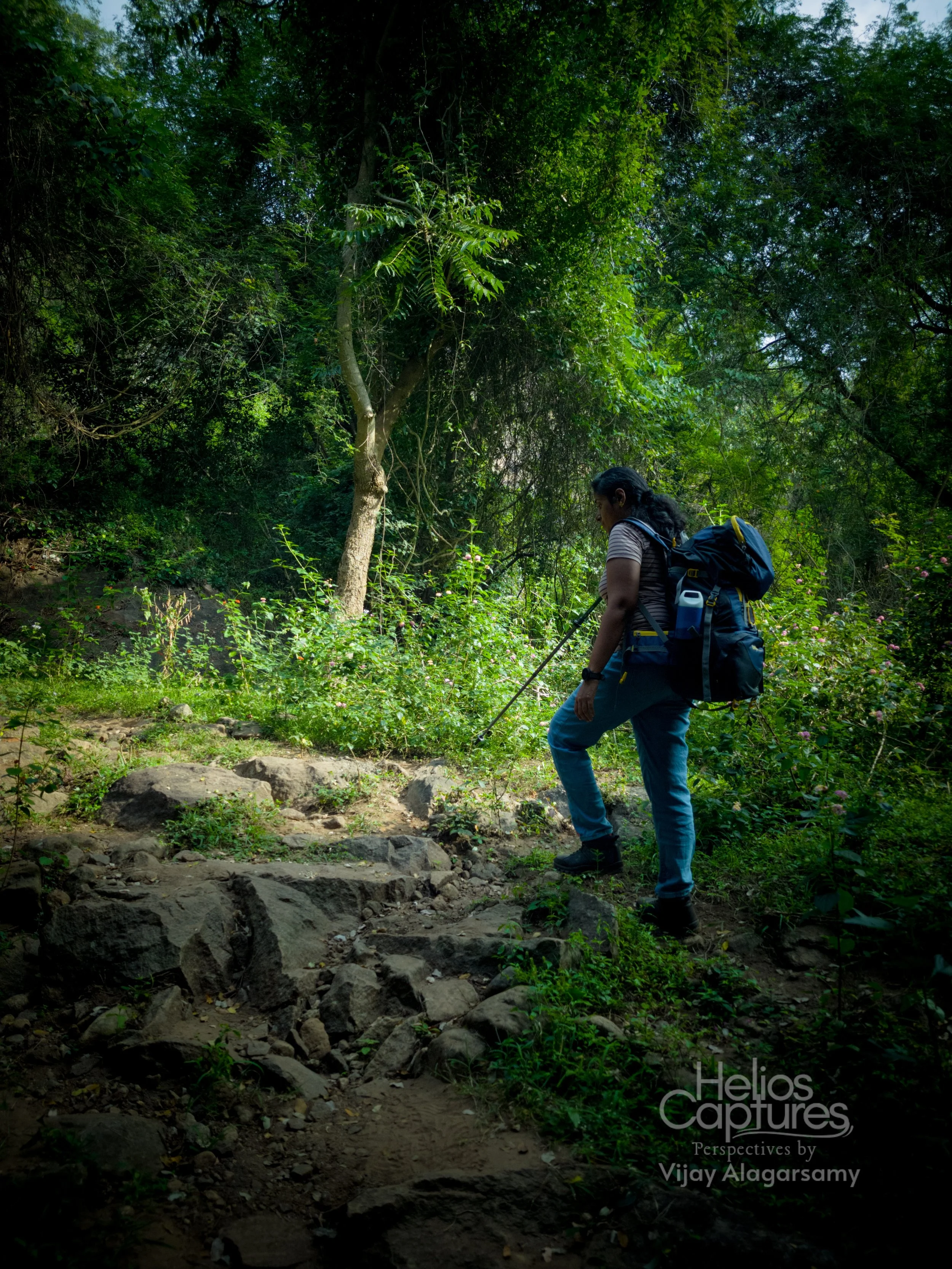
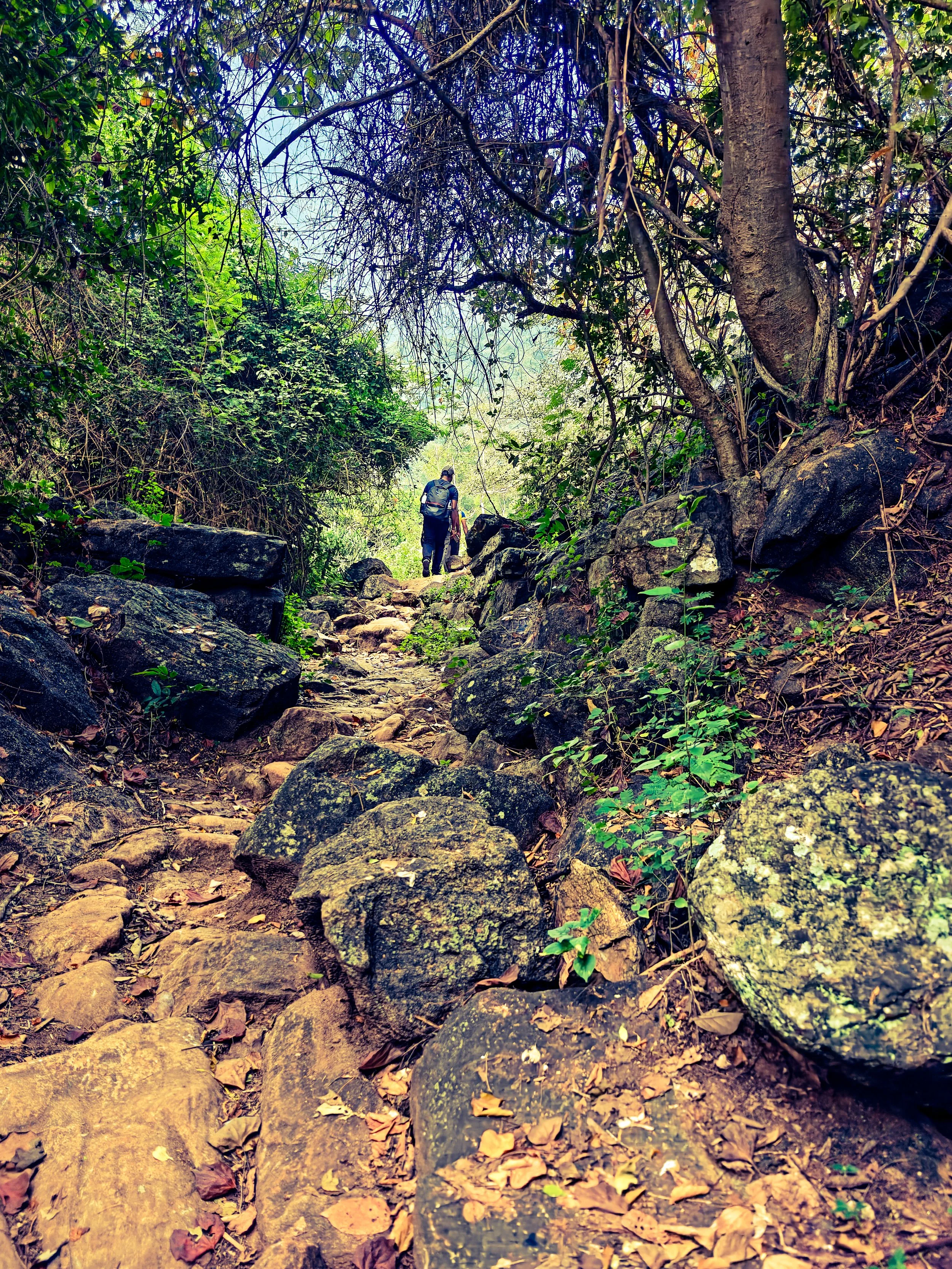
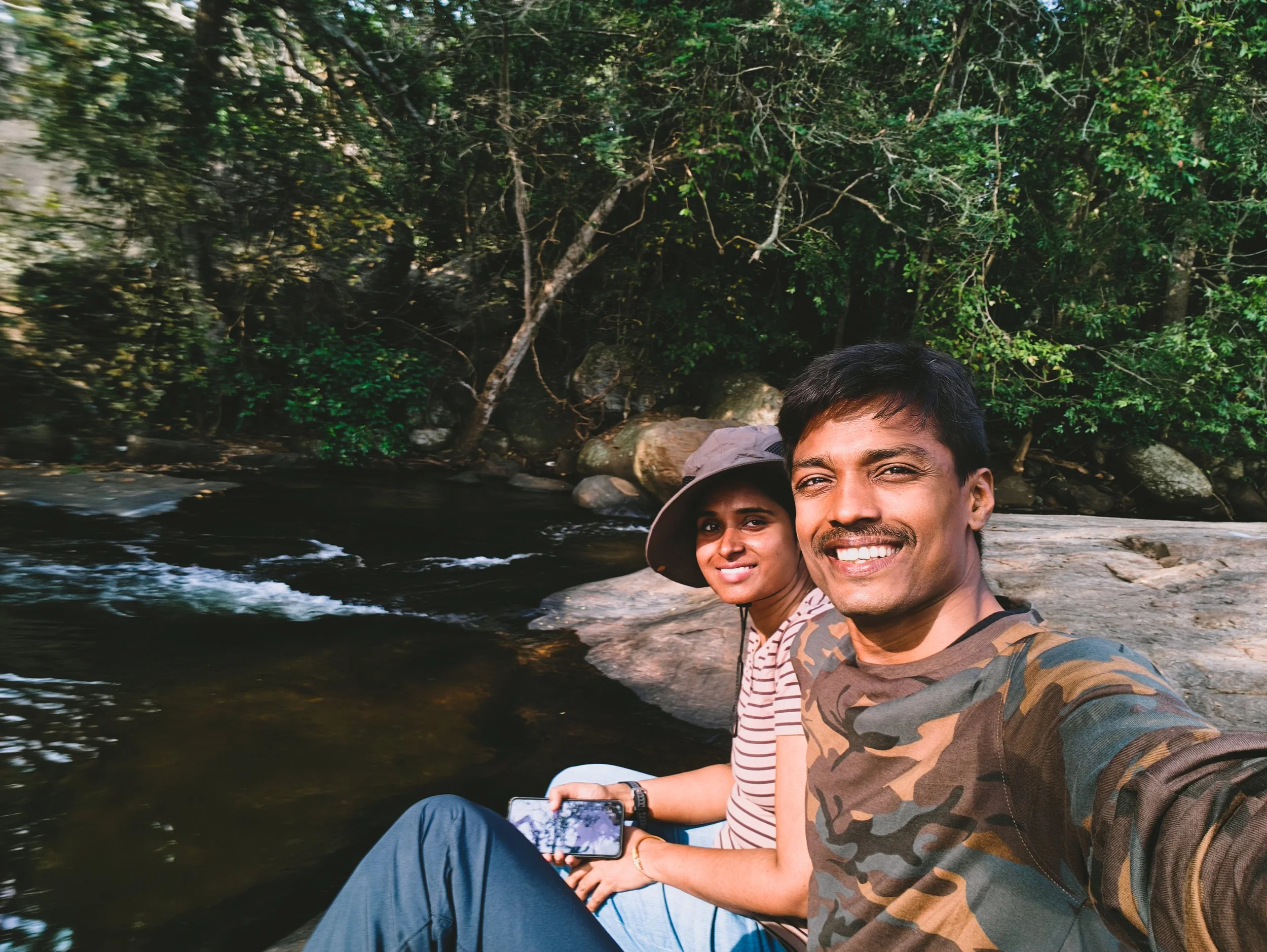
Not because we were tired of each other—but because the forest demanded attention. When the climb grew steeper and breathing became louder, I told her softly,
“Nature is best observed in silence and patience.”
This is where all my years of regular fitness and Tai Chi practice show their true value. Strength training steadied my knees. Cardio kept panic away when the climb stretched longer than expected. Tai Chi helped me stay relaxed even when the trail tested balance and focus.
This is something I strongly believe—and I tell this to anyone who treks with me: When your mind is calm, the body finds a way.
At one point during the climb, I told my wife something that might have sounded strange at first. I told her that throughout the trek, I wouldn’t hold on to anything for support—no branches, no rocks, no shortcuts for grip. I wanted my balance, breath, and posture to do the work.
After a continuous 3 km uphill walk, when the trail had already tested our legs and lungs, I stopped for a moment—not to rest, but to show her something. With my 16 kg rucksack still on my back, I calmly dropped down and did 10 push-ups.
Not to prove strength. Not to impress.
I looked at her and said, “This is what Tai Chi and consistent cardio training give you—not brute force, but control.” When the breath is steady and the mind isn’t panicking, the body responds differently. It doesn’t fight movement; it flows through it.
I wanted her to see that preparation shows up when the body is already tired. That strength isn’t loud. And that endurance isn’t about how hard you push—but about how efficiently you move.
That moment wasn’t about me at all.
It was about helping her trust the work she had already put in.
The lives in nature
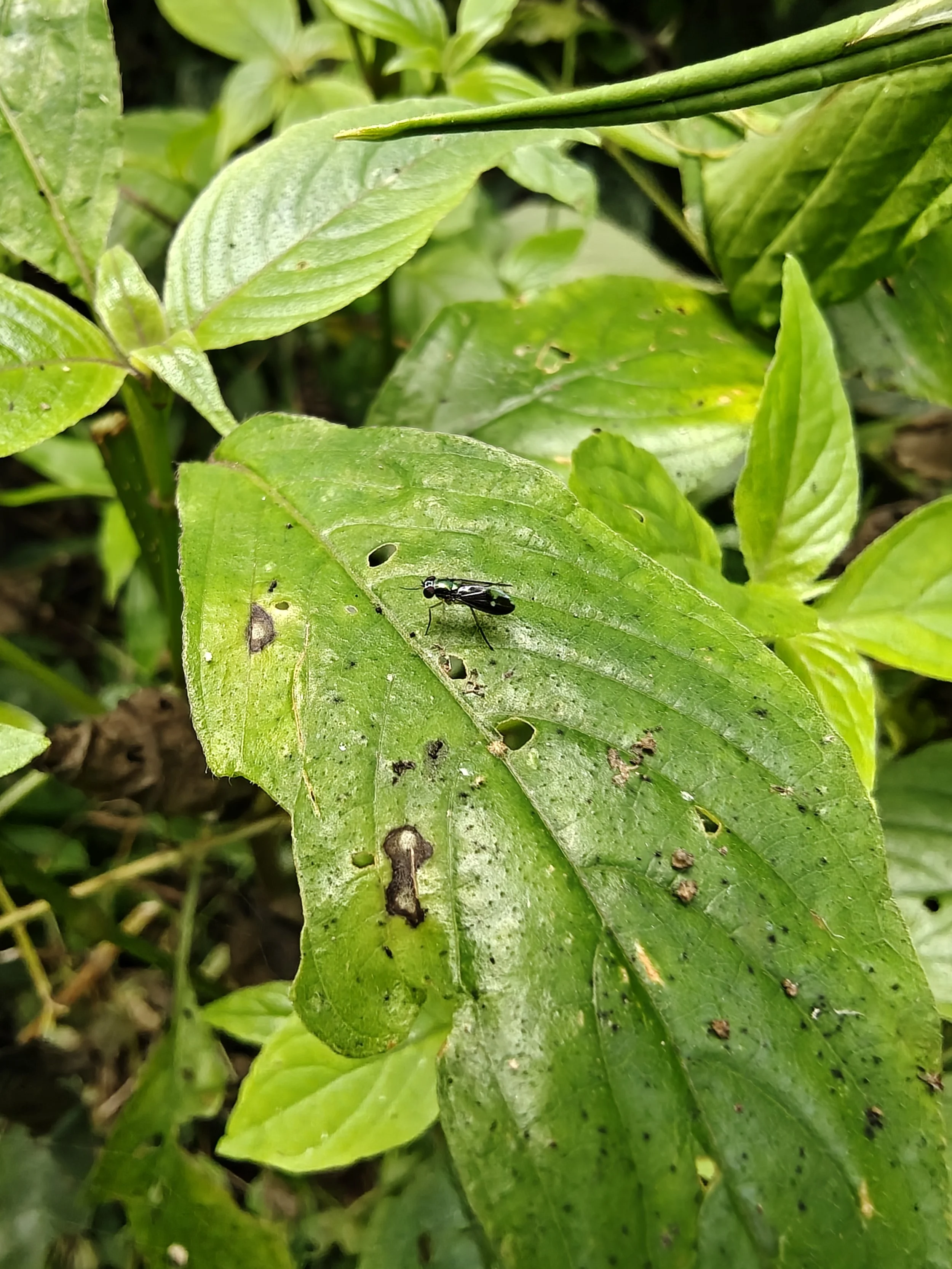
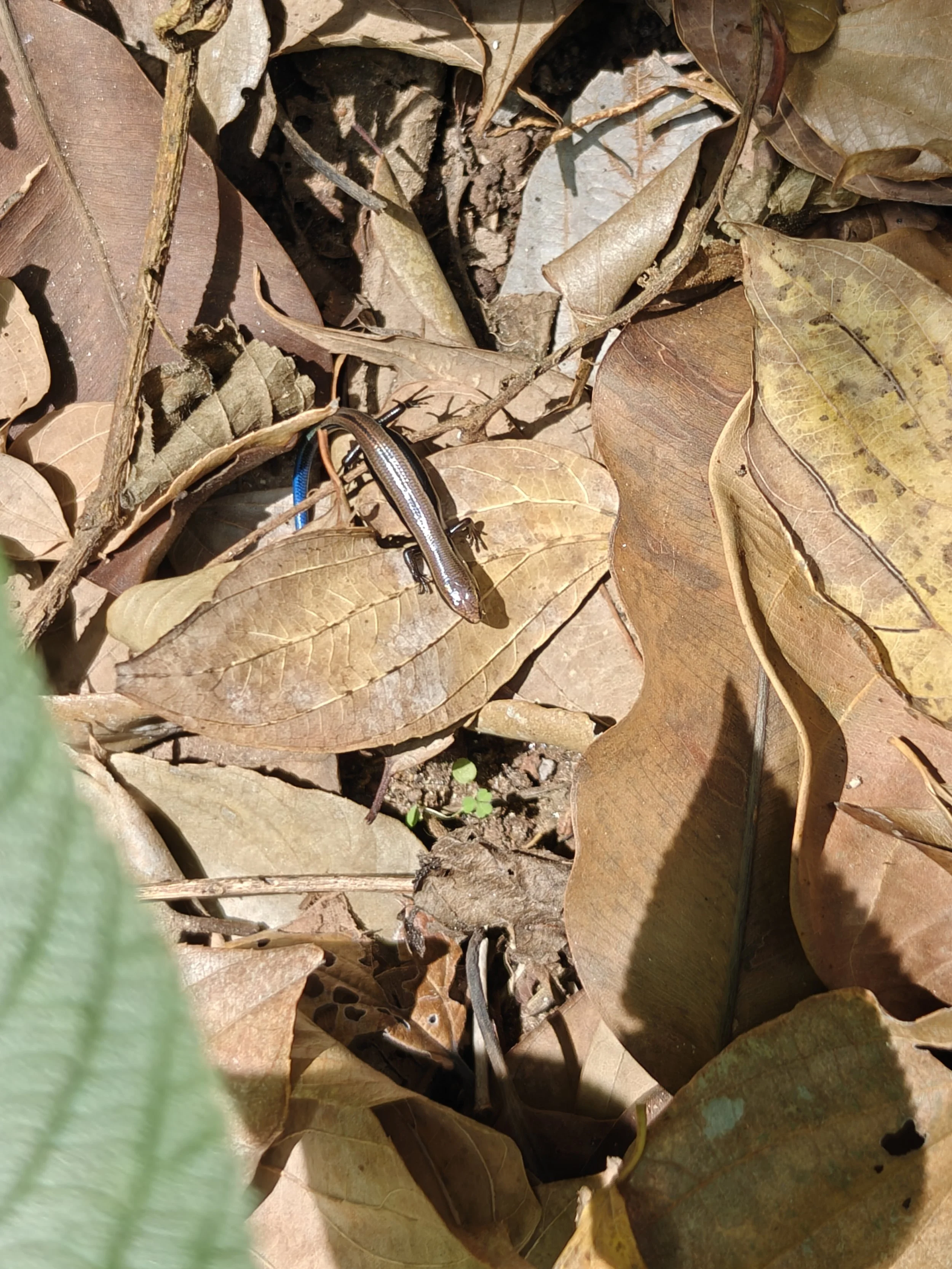
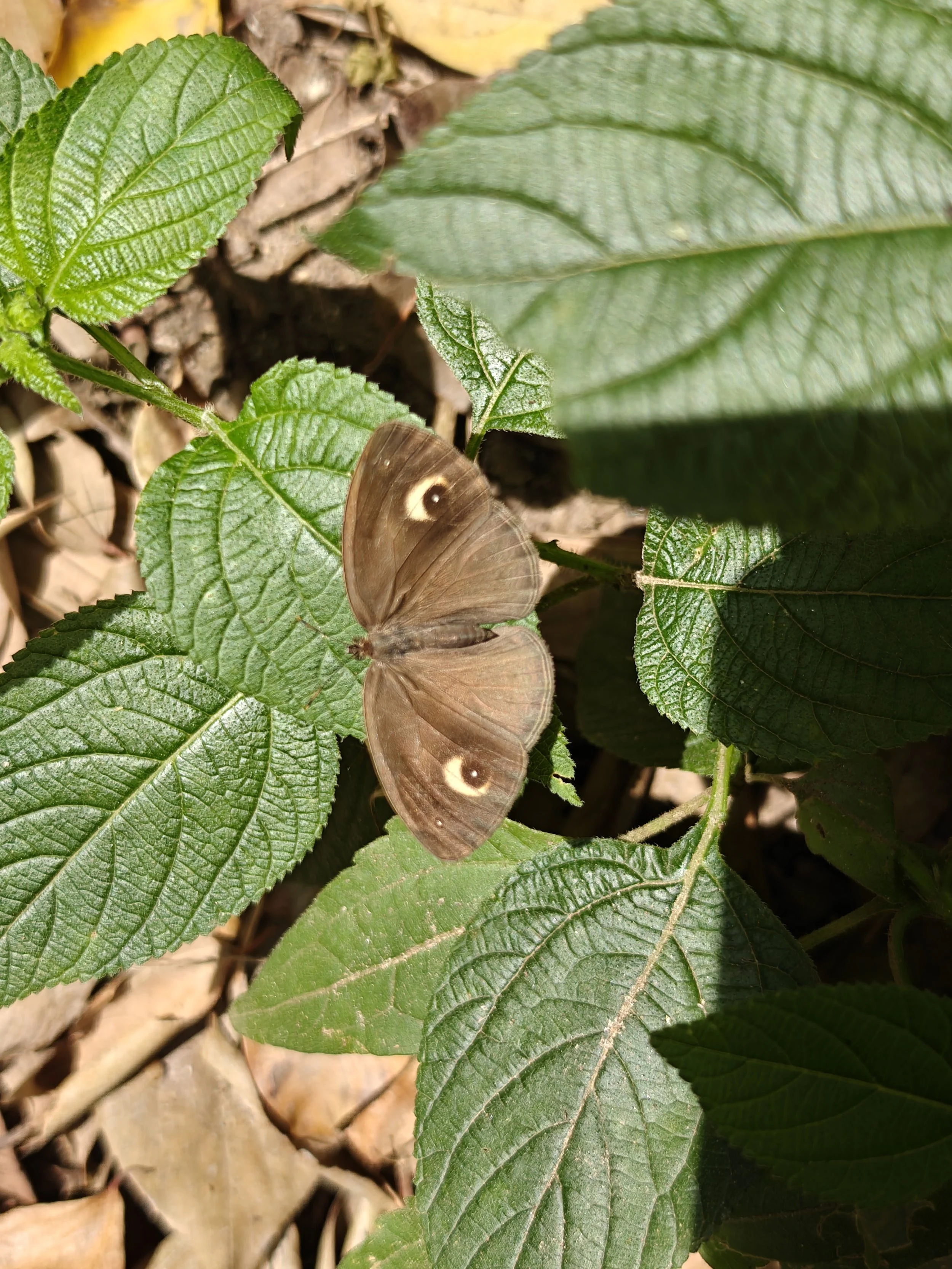
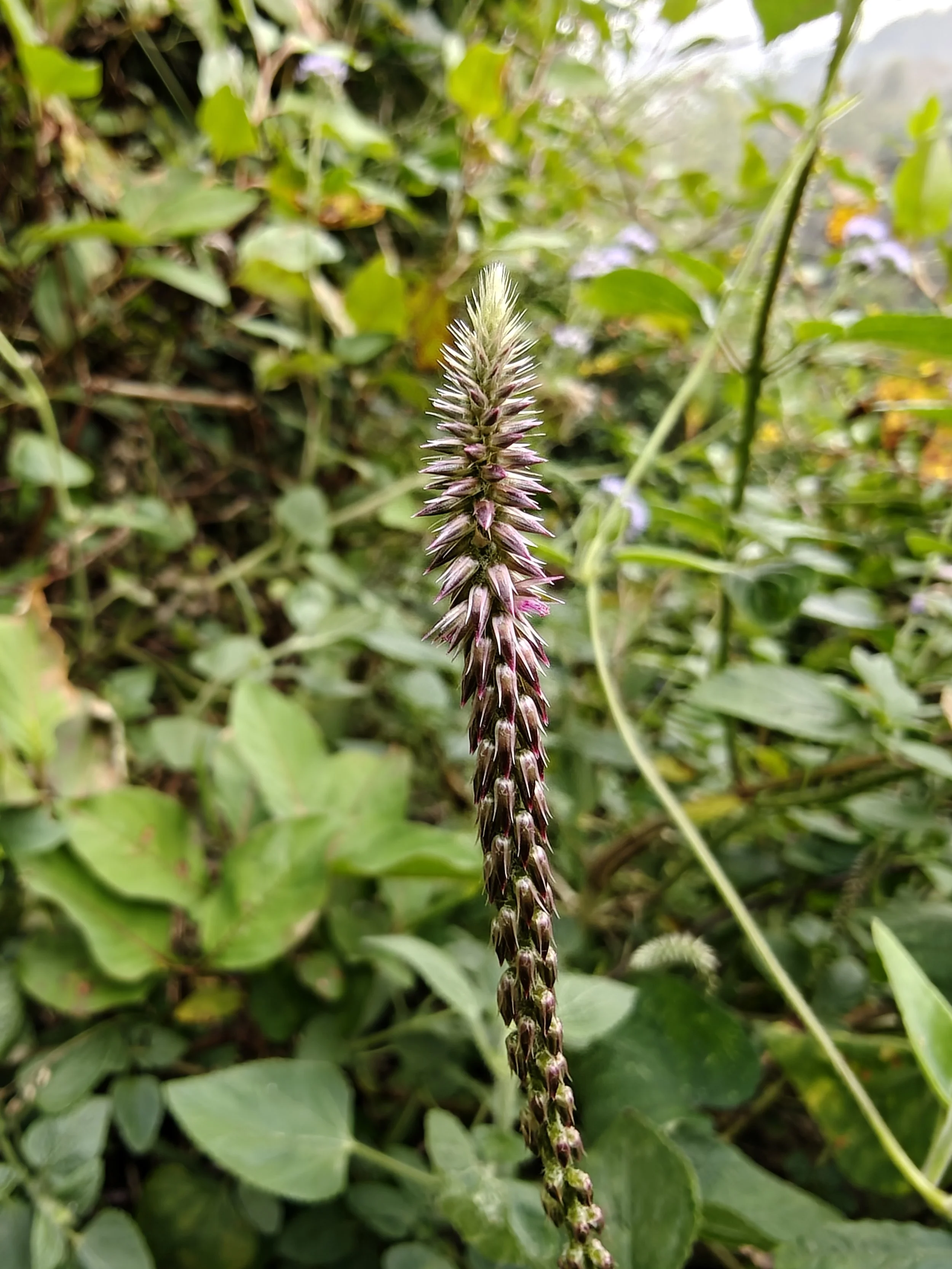
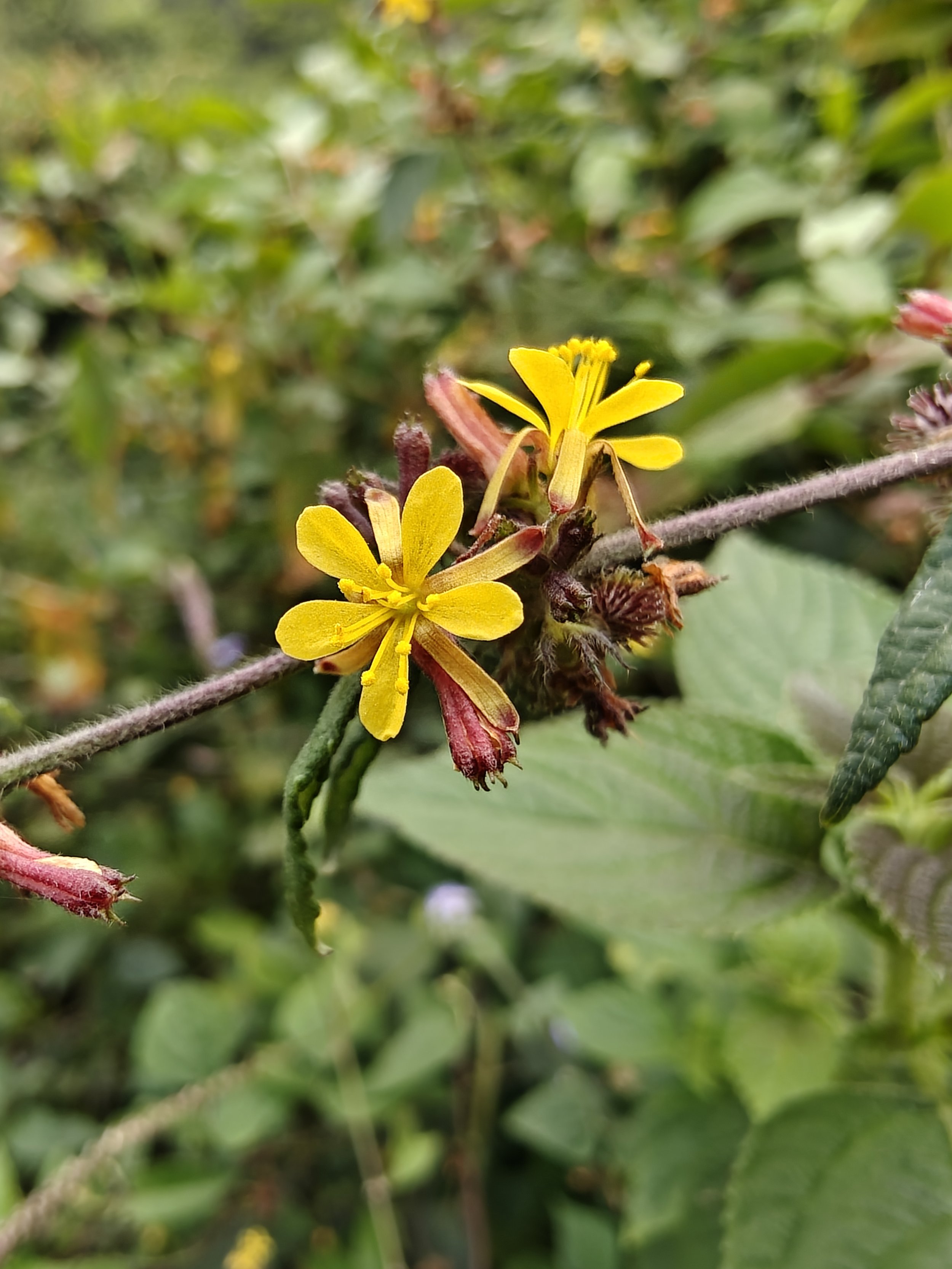
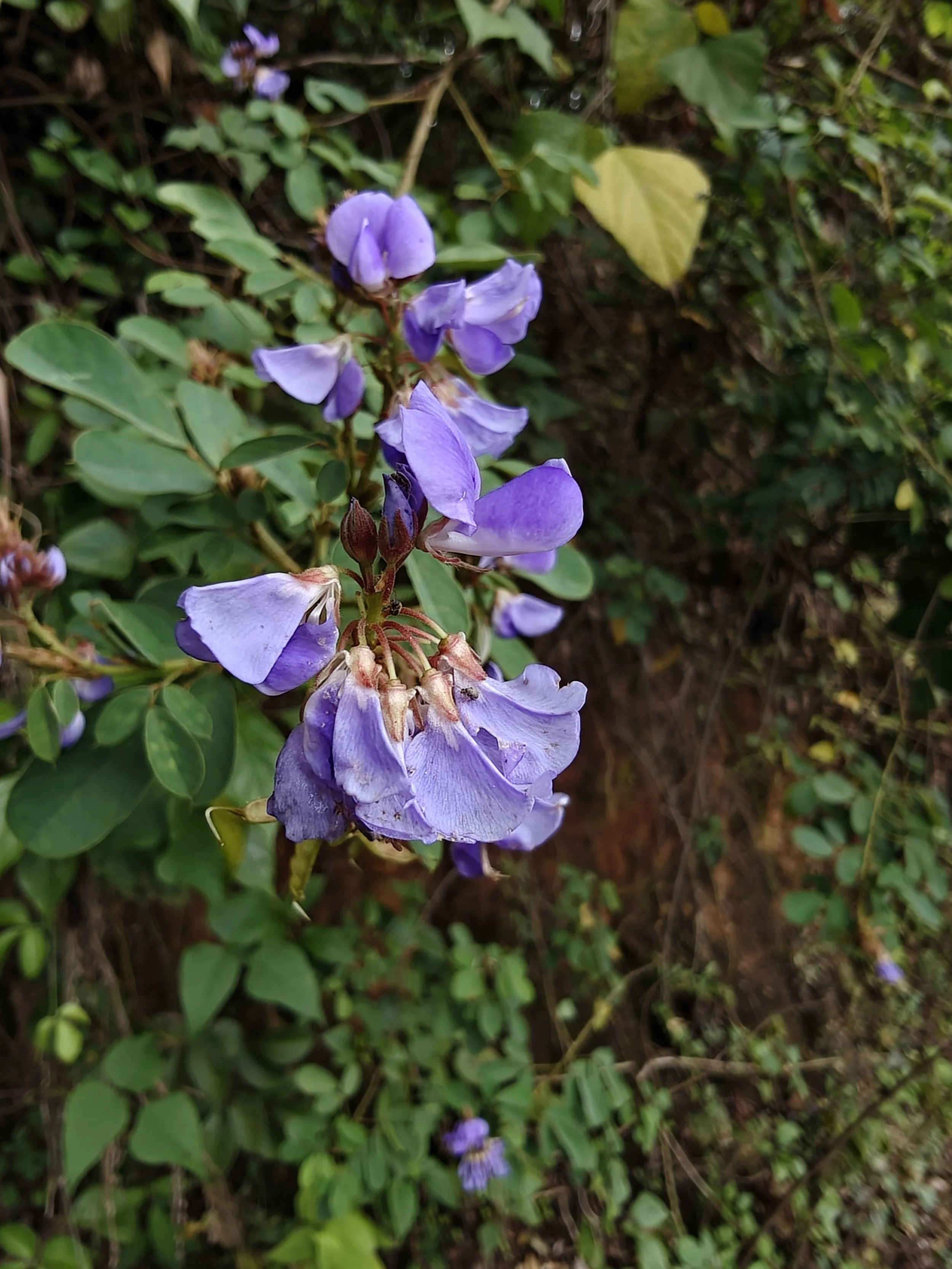
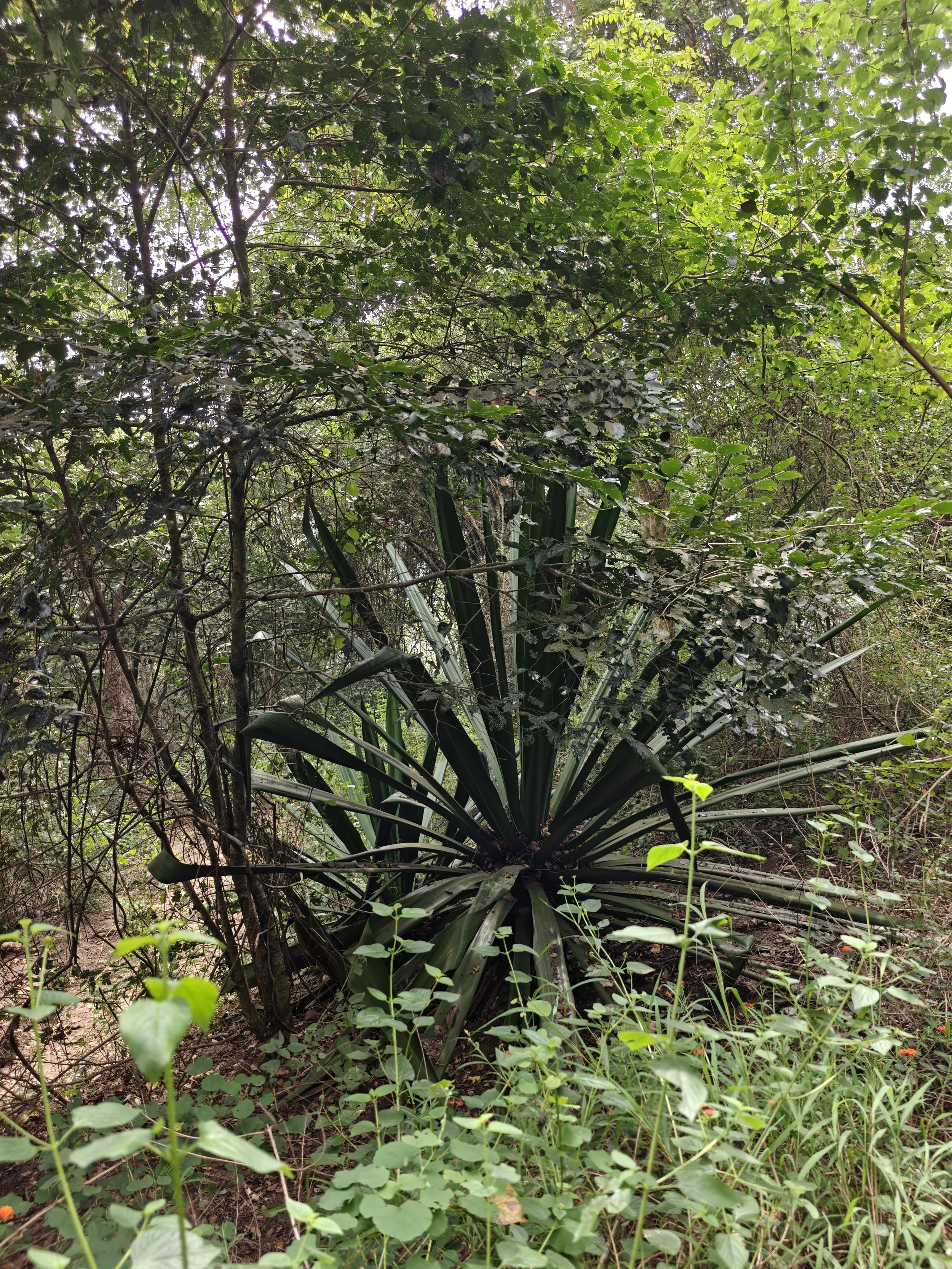
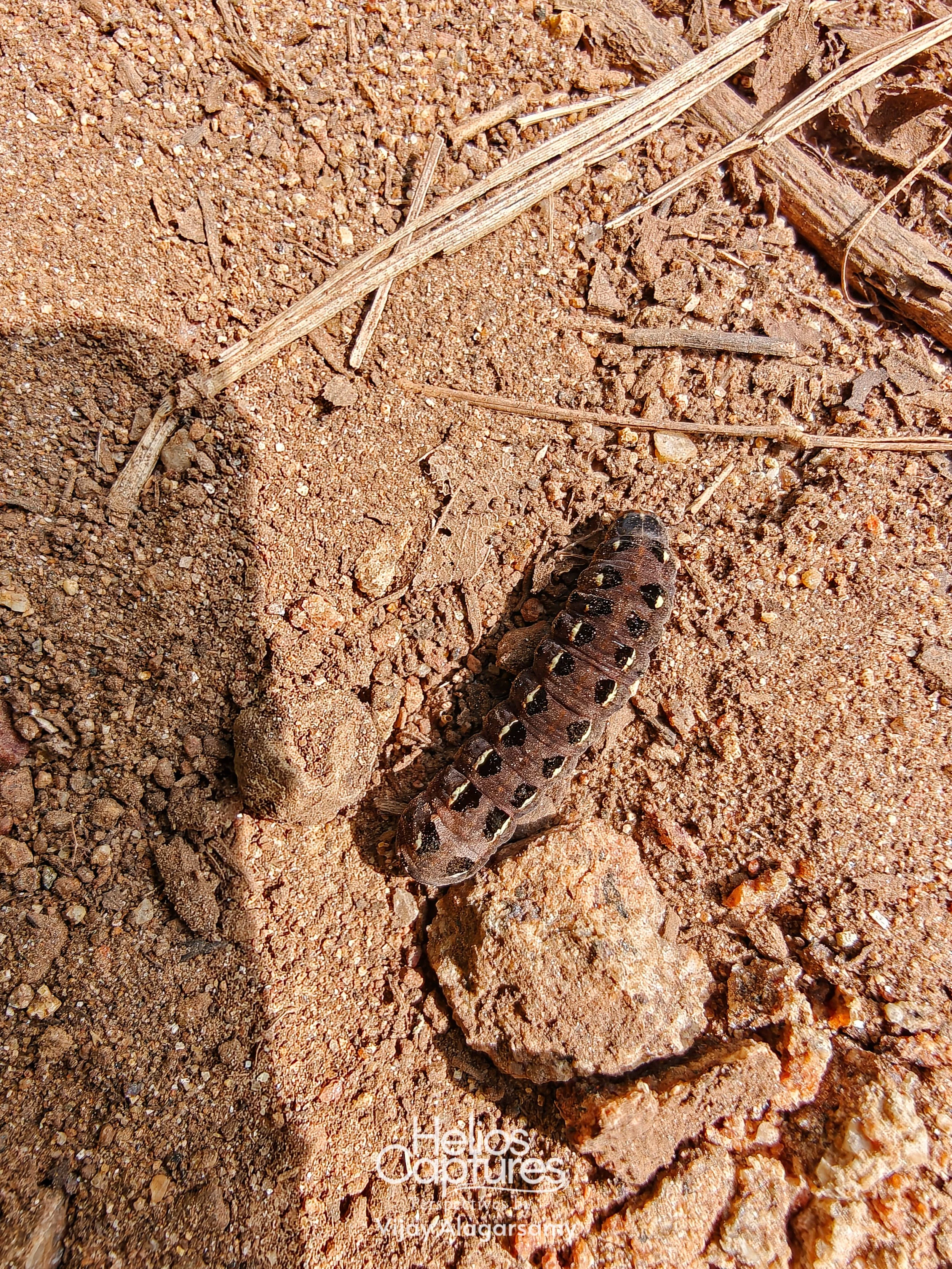
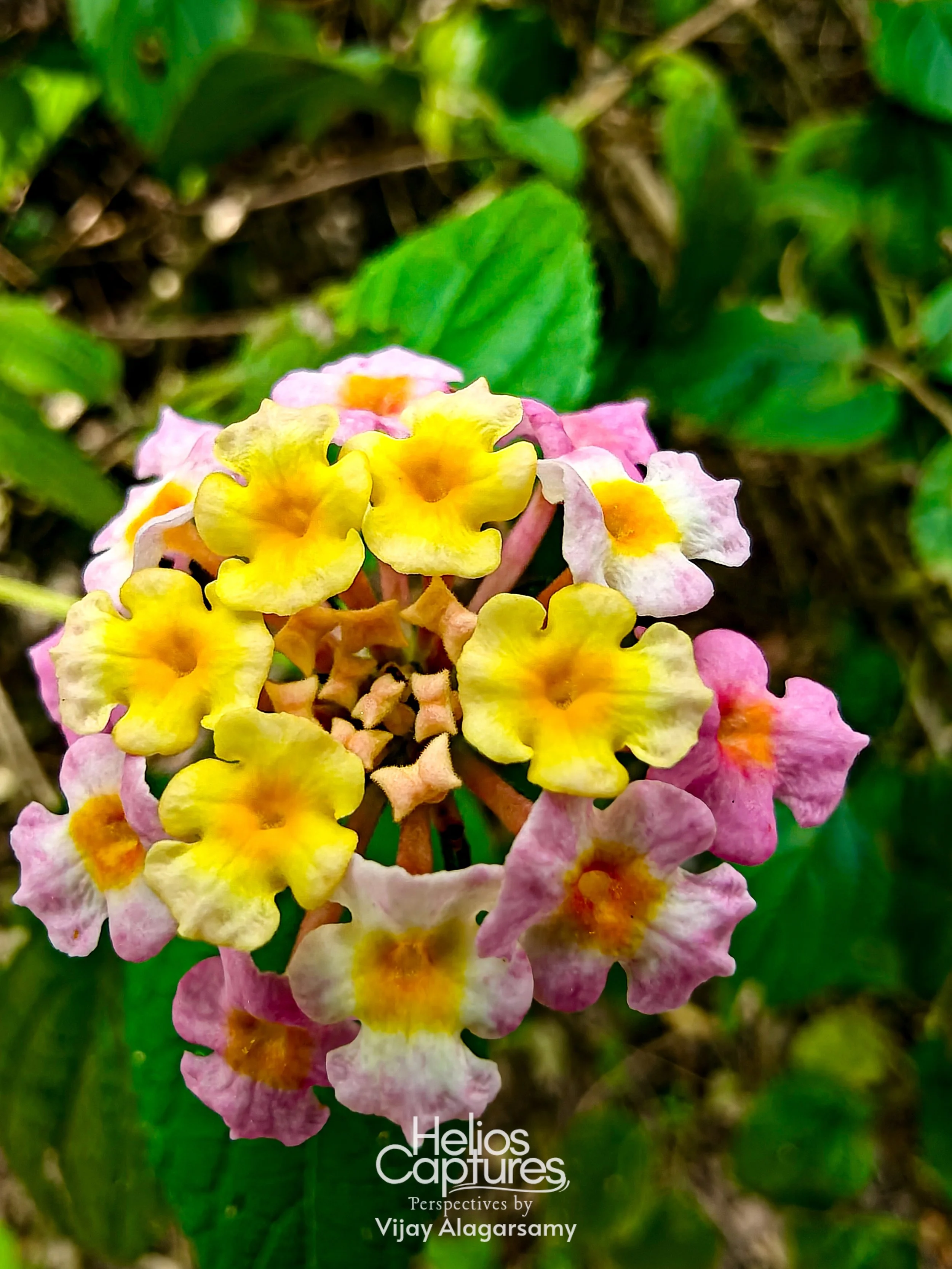
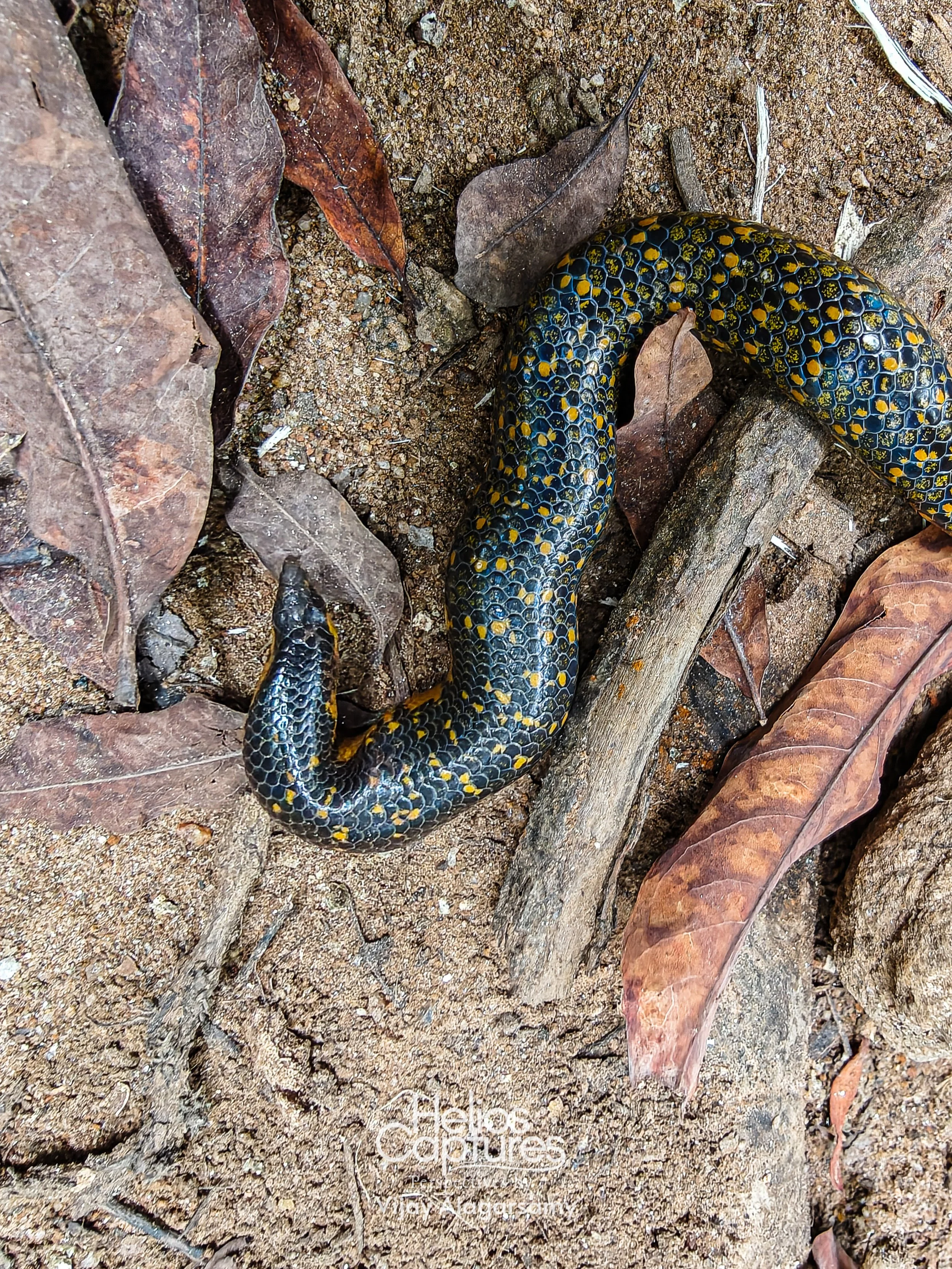
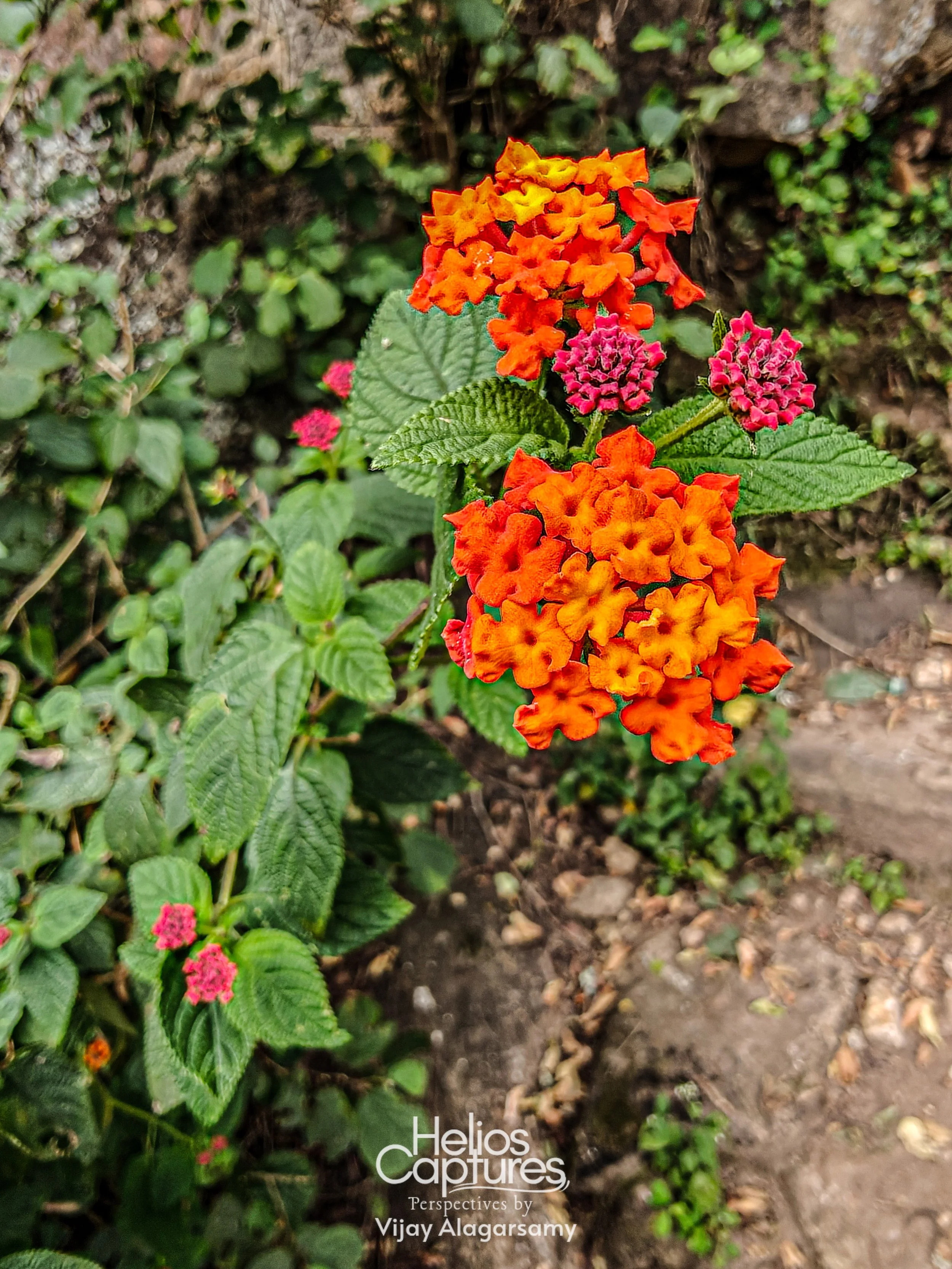
As always, the trail offered me far more than just a path to walk on. I kept pausing—not out of fatigue, but out of curiosity. I observed the small lives that quietly thrive here: the patterns of spiders stretched between branches, tiny insects disappearing into bark, caterpillars moving with patient determination, and subtle signs of snake movement that remind you this forest is very much alive.
I photographed whatever the forest allowed me to notice—lantana flowers adding unexpected bursts of colour, coffee plants growing calmly under shade, avocado trees standing tall and generous, and even a glimpse of the Wood mason’s earth snake (Uropeltis Woodmasoni), the Travancore Ground Skink (Barbour’s Skink) blending so perfectly into its surroundings that it felt more like a lesson in camouflage than a wildlife sighting.
I told my wife, “When you slow down enough, the forest starts introducing itself.” These moments reminded me why I never rush on a trail. The real journey often happens at eye level; in places most people walk past without noticing.
A mysterious tomb
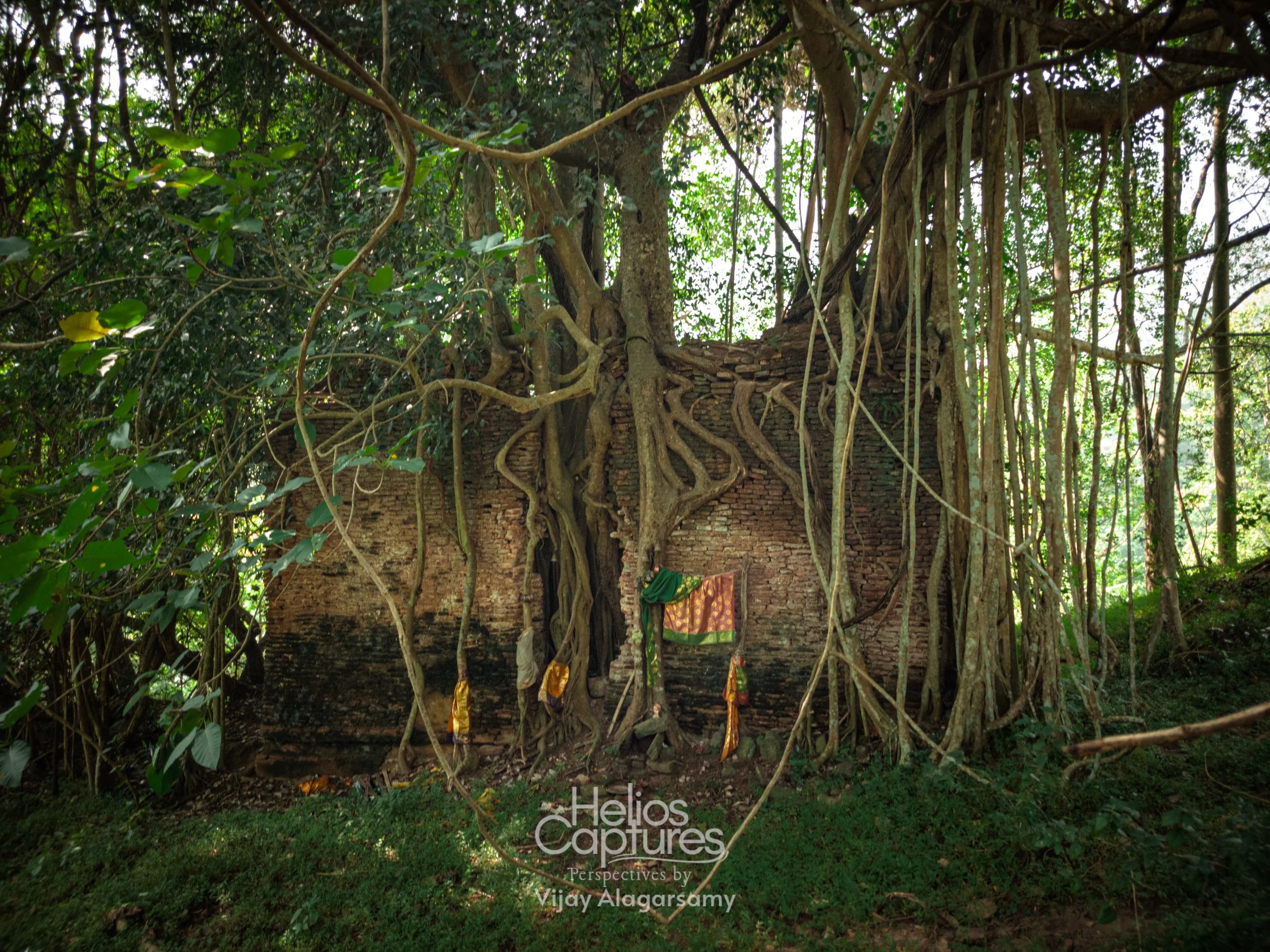
As we moved deeper into the forest, we noticed a temple-like stone structure, standing quietly beside the trail. It didn’t look abandoned, but it didn’t look active either—just present, as if the forest itself was guarding it.
Curious, I asked a local villager walking along the route about it.
He told us that, according to what has been passed down in the village, this place was once used as a hiding spot during the time of Tipu Sultan’s invasions. People fleeing violence are believed to have taken shelter here—and some, he said quietly, never returned, eventually being buried beneath the ground around this structure.
There are no inscriptions. No written records. Just memory—carried forward through generations.
I didn’t ask more questions after that. I told my wife softly, “These mountains have protected people long before they inspired trekkers.” We stood there for a moment in silence, acknowledging the space, before continuing our walk.
Places like this remind me that the trail is not just made of soil and stone—it is layered with fear, survival, faith, and forgotten lives. And when you walk through such spaces, the least you can do is walk gently.
Walking Into a Sacred Village
We reached Vellagavi Village around 3:00 pm. Those six hours weren’t spent chasing speed. They were spent listening—to breath, to footsteps, to the forest slowly opening itself to us.
Vellagavi didn’t greet us with drama.
It greeted us with dignity.
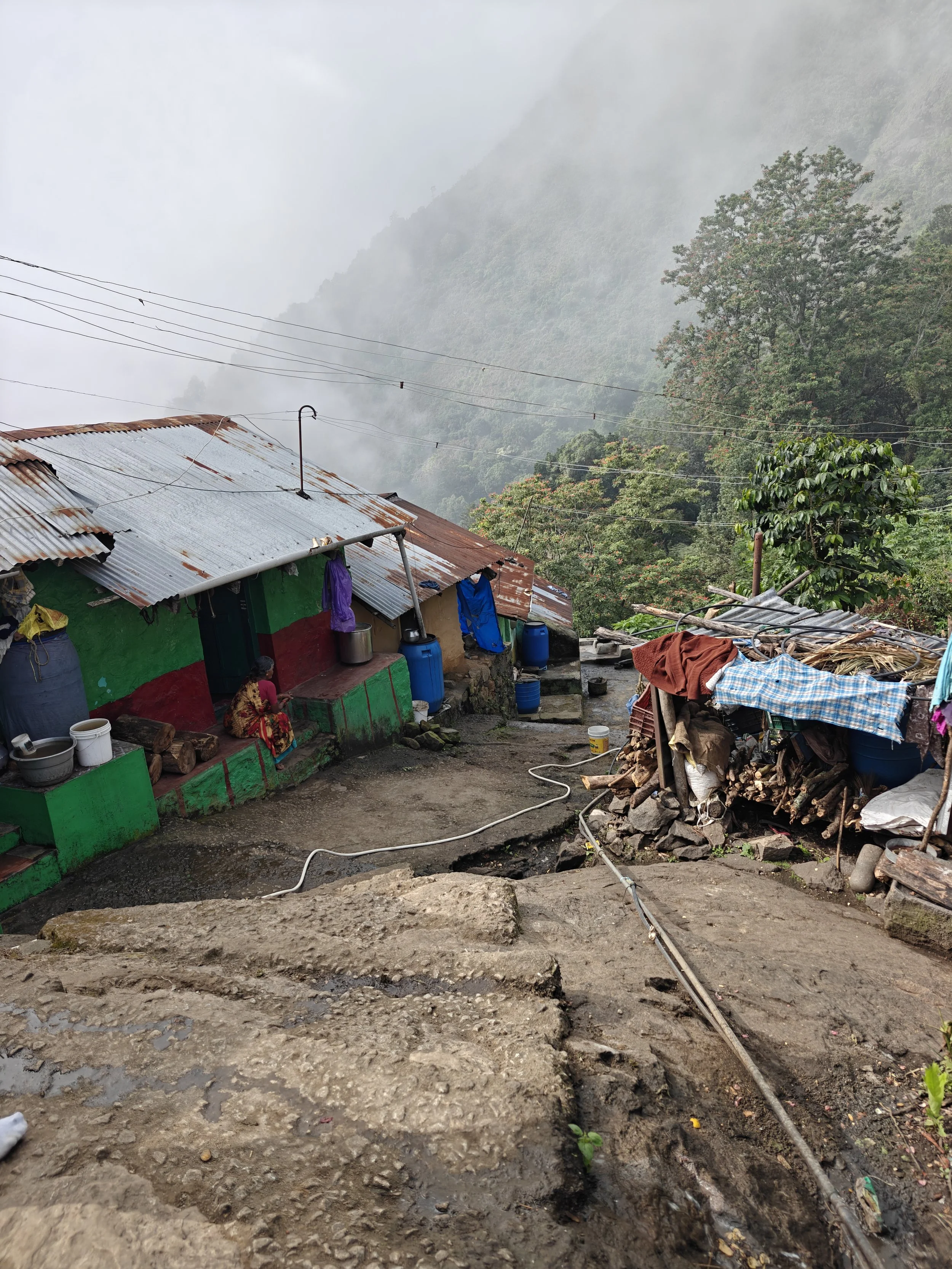
Stone houses. Mud paths. Quiet smiles from locals who live in harmony with the mountain, not on top of it. This village doesn’t perform for visitors. It simply exists—and that itself feels sacred.
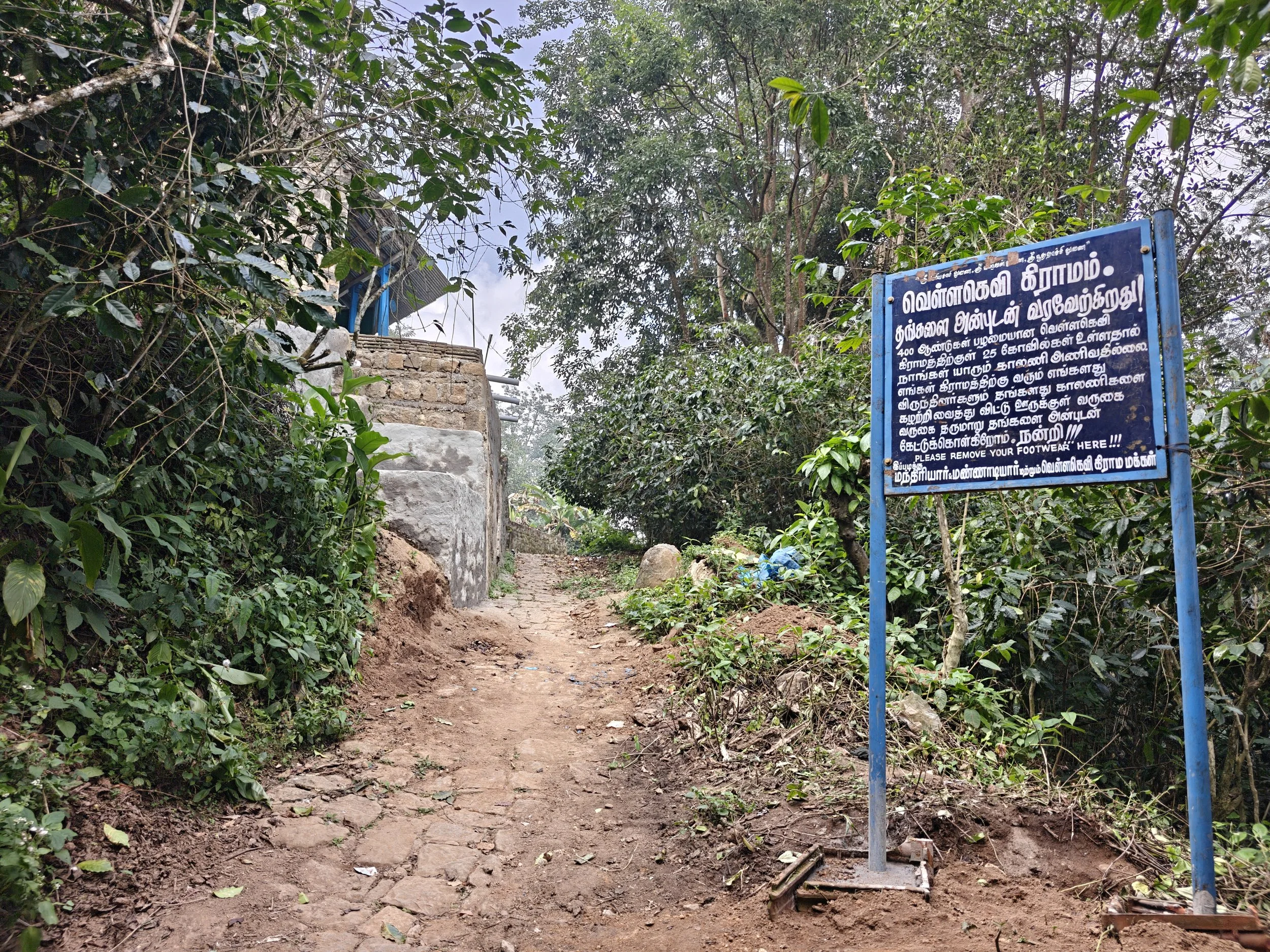
Right at the entrance of the village, a large board asks visitors not to wear footwear inside Vellagavi, reminding everyone that this is a sacred space. I paused there for a moment. Removing footwear felt symbolic—like leaving behind not just sandals, but also noise, hurry, and entitlement.
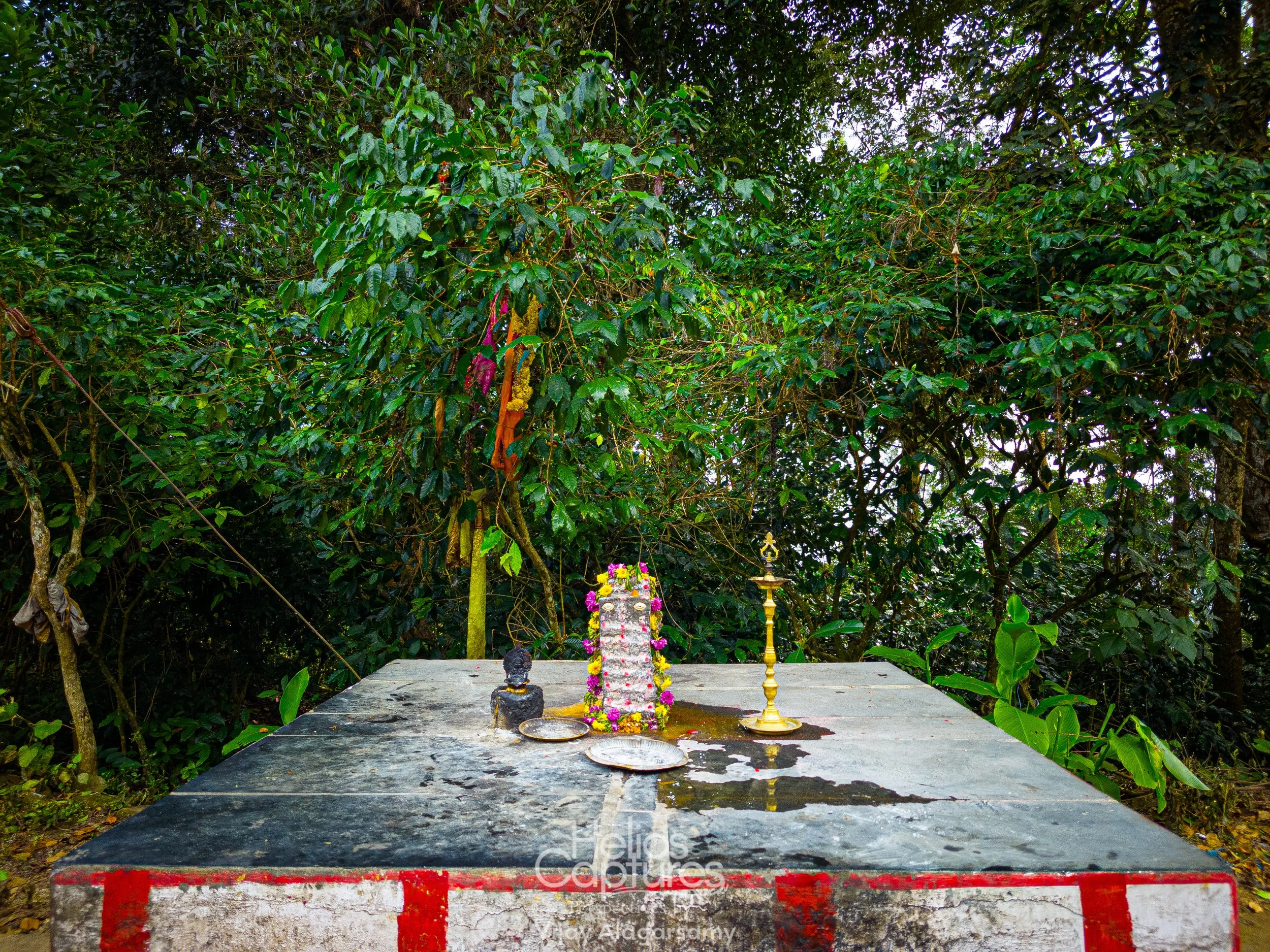
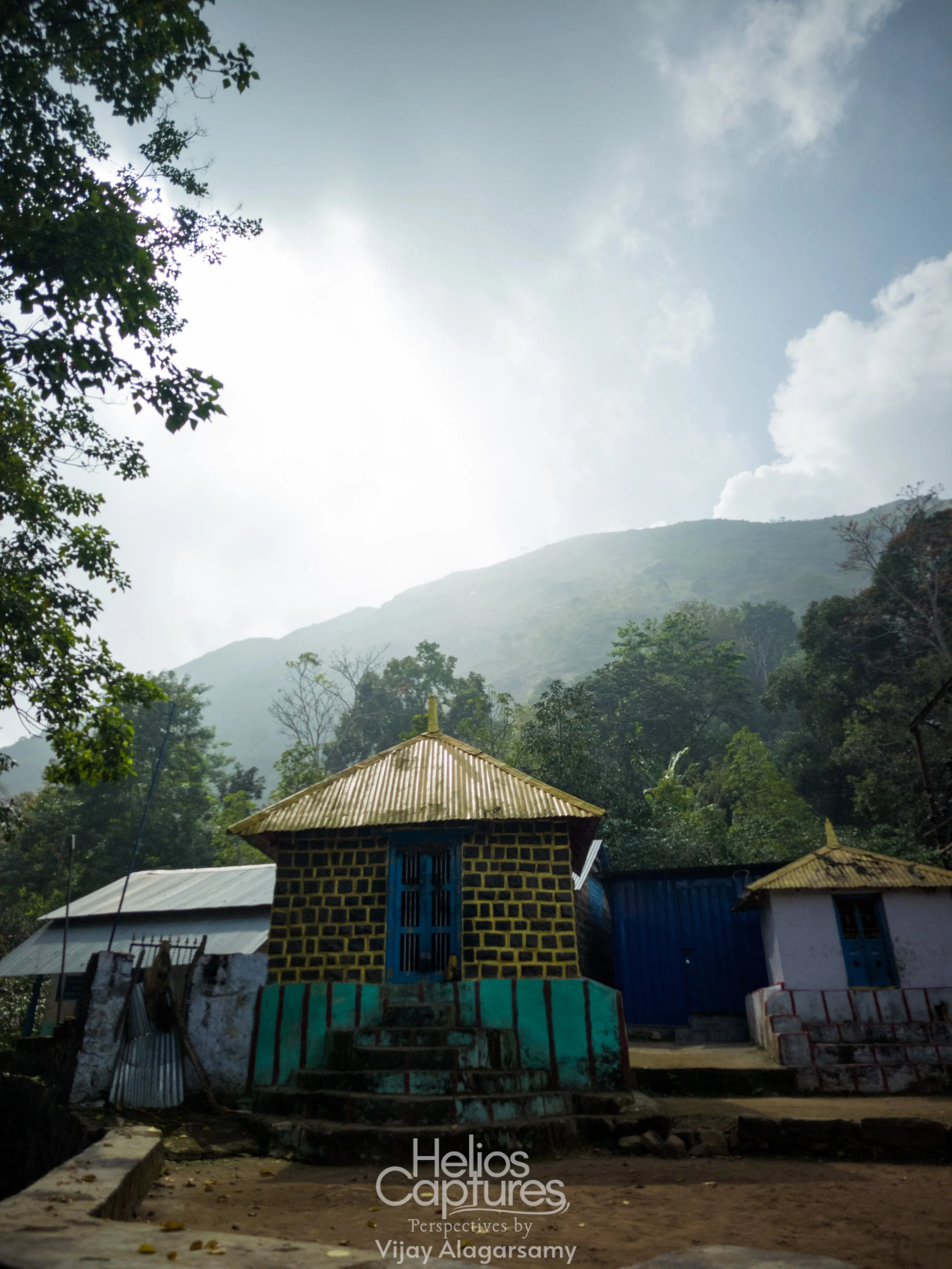
Vellagavi has around 50 houses, and astonishingly, more temples than homes. Whichever direction you walk, you encounter idols—silent, weathered, and deeply respected. The village traces its roots back to the time of Tipu Sultan, when people settled here and slowly formed an isolated mountain community. Over generations, they built a life centered on faith, land, and self-reliance.
The villagers worship many gods, and they consider their land profoundly sacred. Until recent years, no one wore footwear inside the village—not even the locals. Outsiders weren’t welcomed either. But time has softened boundaries. Today, visitors are allowed, and there’s no reluctance—only a quiet expectation that you arrive with humility.

Life at 6,500 Feet (1997 MSL)
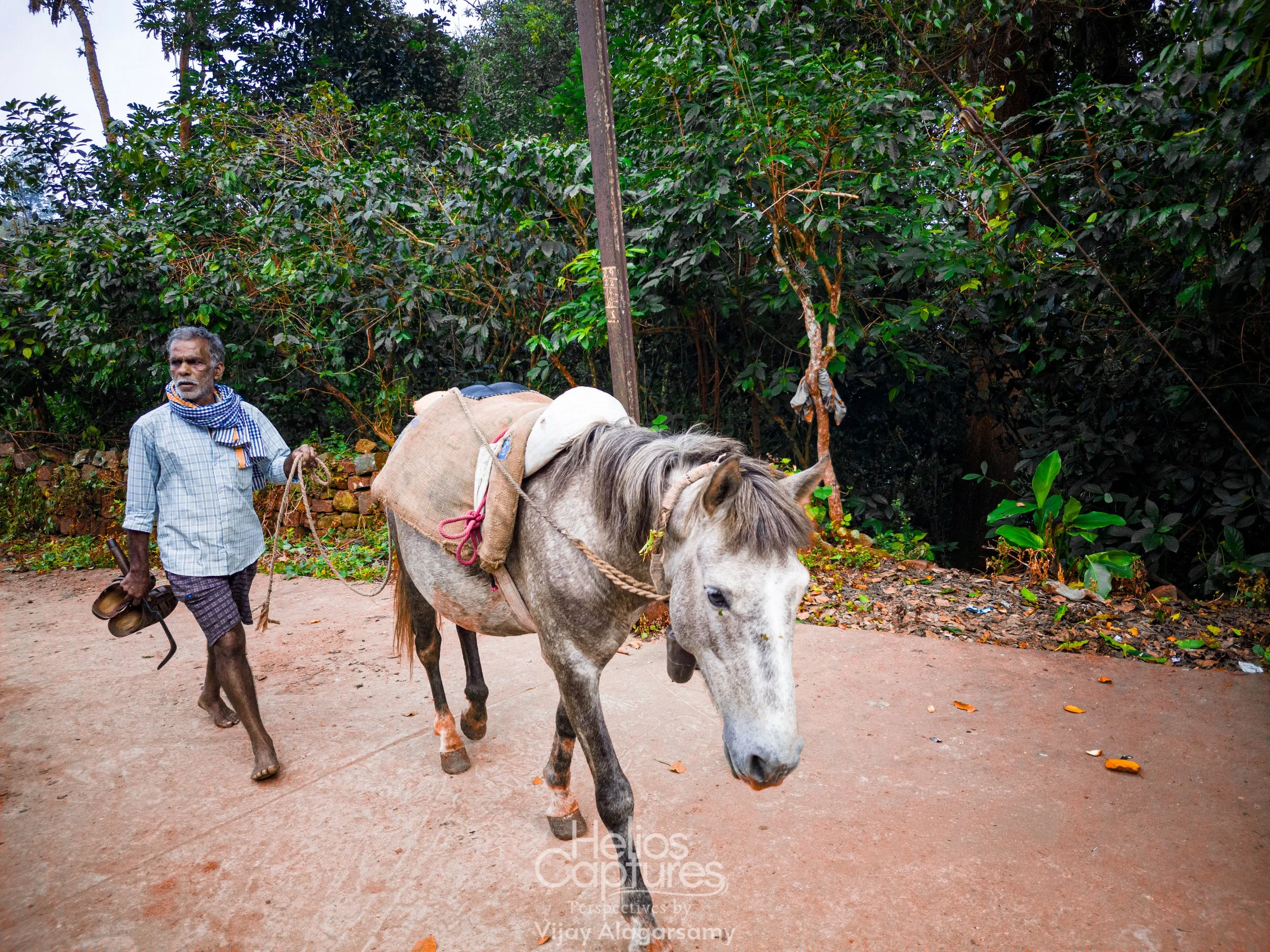
Most people here are farmers. Coffee and avocado are the primary crops, grown patiently on steep mountain slopes. Every morning, a few horses climb all the way to Kodaikanal to bring essential supplies back to the village. Watching that cycle made me realise how self-organised and resilient this place is.
There’s a primary school till 5th standard in the village. Beyond that, children must travel to Periyakulam or Kodaikanal for education. Many of the younger generation now work outside the village—but the roots remain strong.
What struck me the most was the health of the people. Even a 90-year-old doesn’t look fragile here. Their bodies carry strength that comes from daily movement, clean air, simple food, and a life lived close to nature. It silently questioned everything we call “modern living.”
A Campsite That Felt Like Community
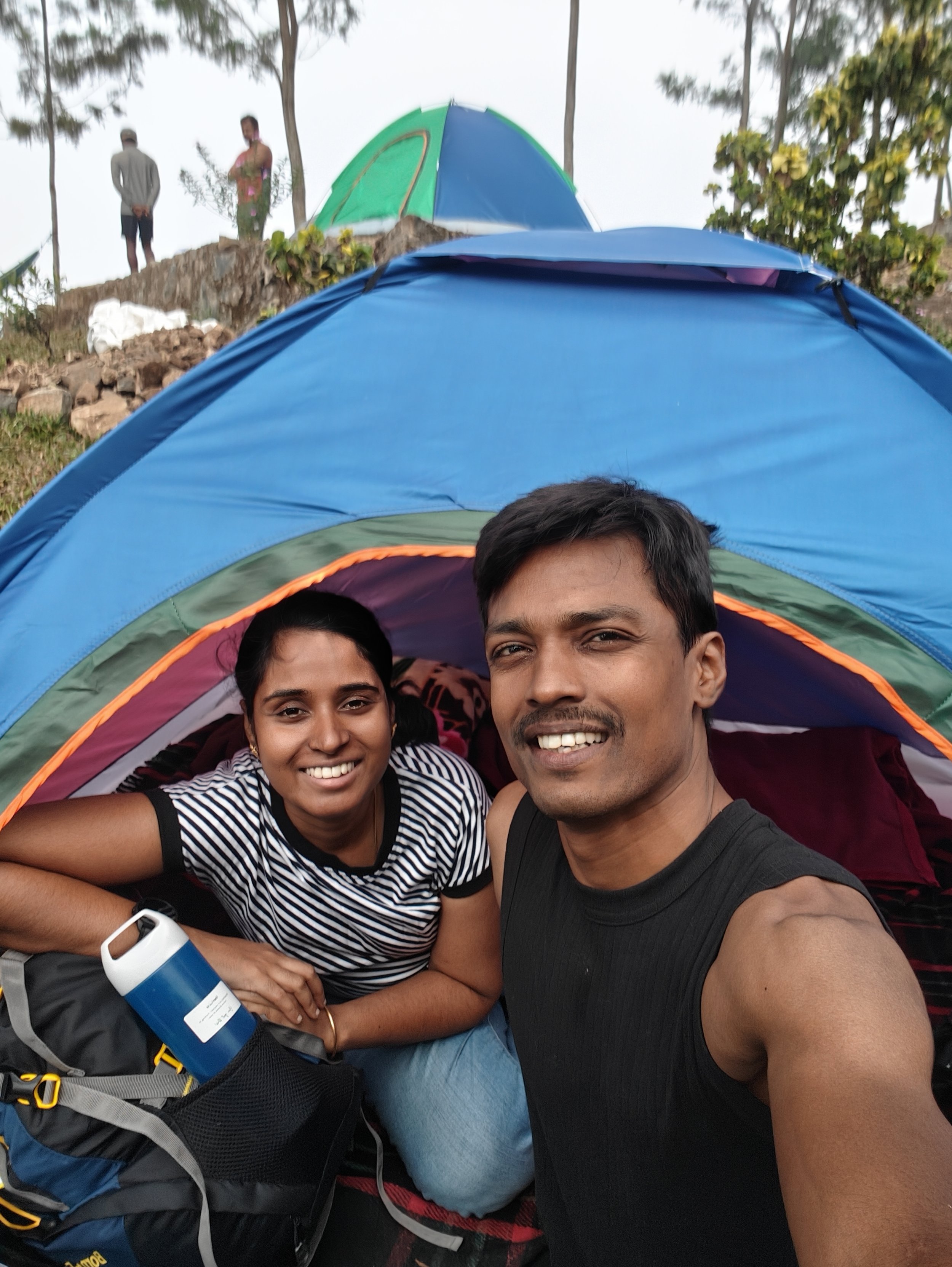
We stayed at Old Kodai Camping, run by Thiru.Jaga Murugan, a person from the village itself. Places feel different when they’re run by people who belong to the land. There’s a quiet dignity in how things are done—no rush, no excess, just enough.
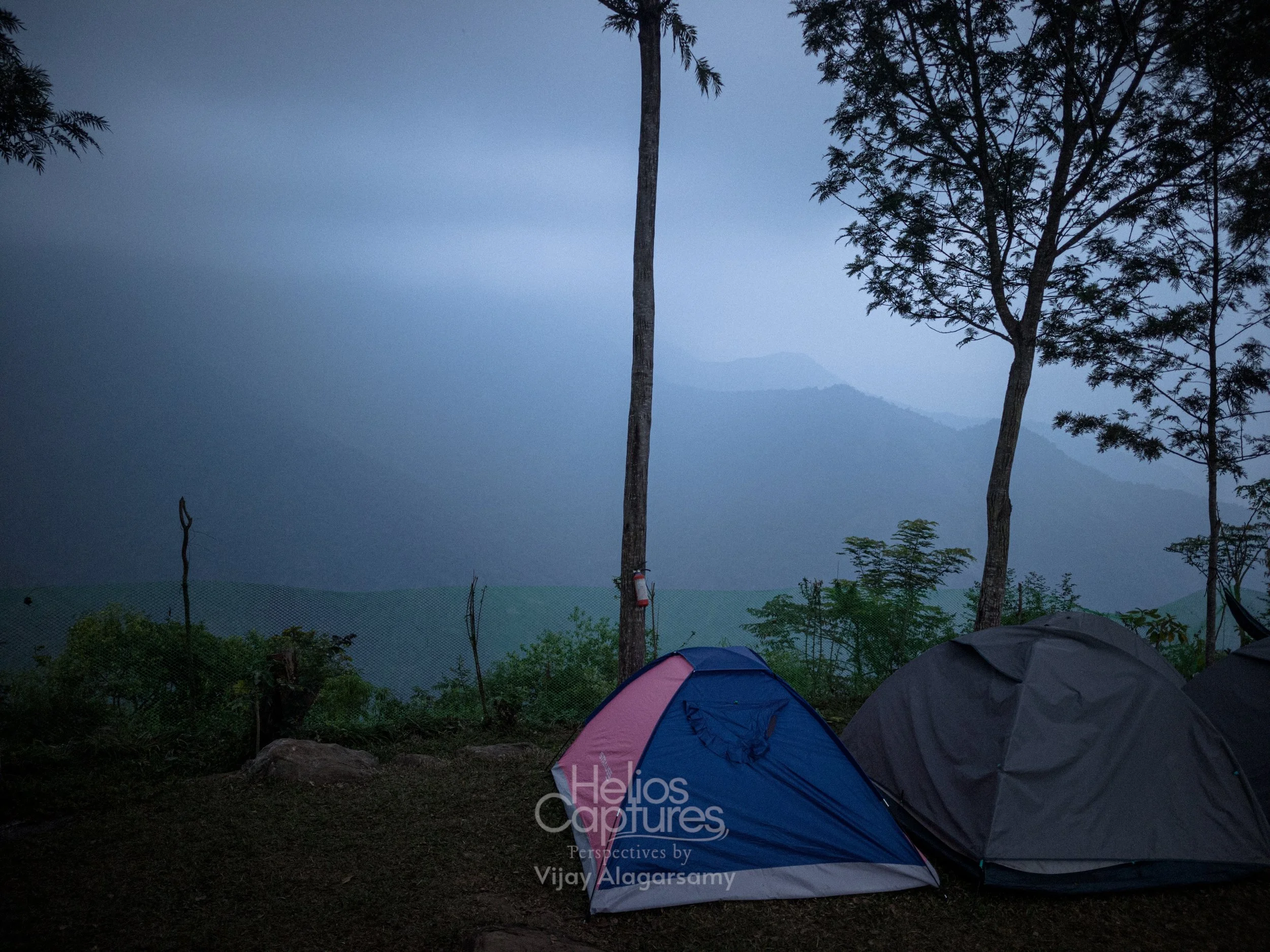
By evening, the campsite came alive. Trekkers began arriving from different routes—some walking down from Vattakanal to Vellagavi and onward to Kumbakarai. In total, there were 21 of us at the campsite—and interestingly, only two were couples.
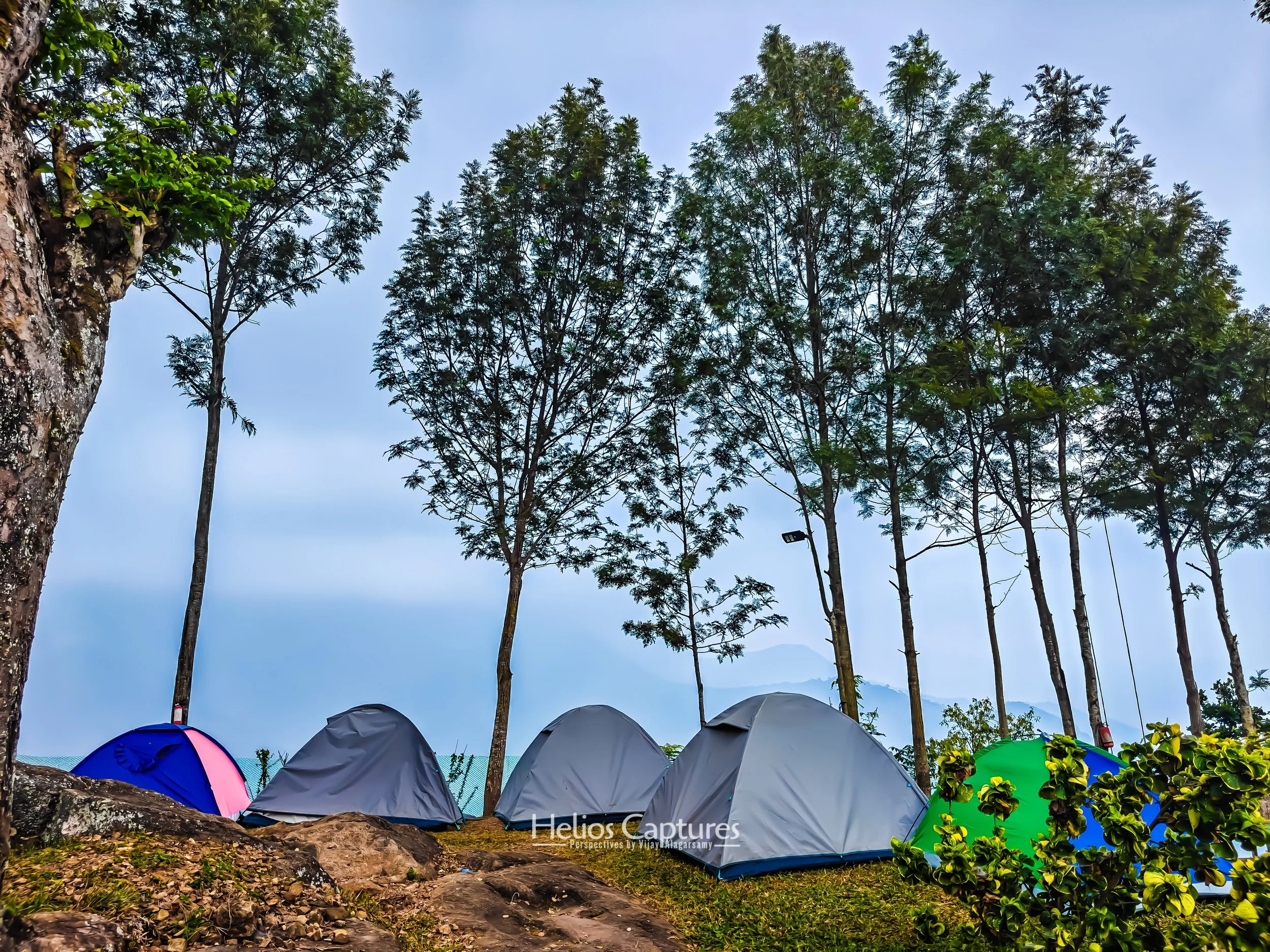
We dropped our bags inside the tents, and conversations began naturally. There was no awkwardness—just shared exhaustion and shared curiosity. We had lunch, rested for a while, and later stepped out for evening coffee in the chill mountain air.
That coffee break was special for us. Just the two of us, sitting quietly, watching clouds drift past the village edges. No phones. No rush. Just warmth in our hands and silence around us.
As evening approached, something magical happened. Clouds began rising from the valleys below us, slow and steady, wrapping the hills layer by layer. The sun dipped lower, painting the sky in shades that don’t stay long enough to be photographed properly.
Standing there, I told her, “This is why we prepare. Not to rush—but to arrive without exhaustion.” At that moment, it felt like the mountain had allowed us to rest—not just physically, but emotionally.
Fire, Stories, and a Quiet New Year
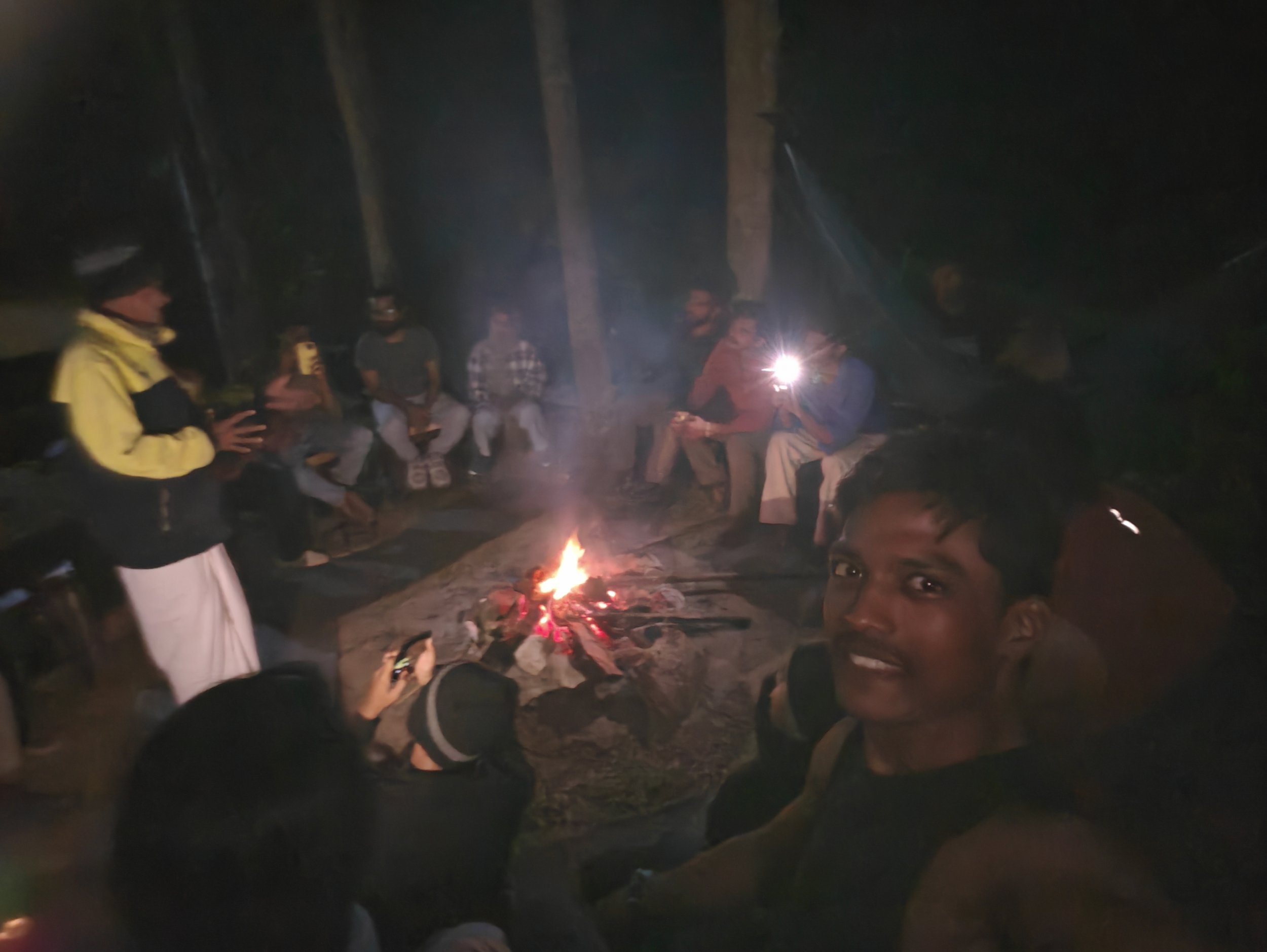
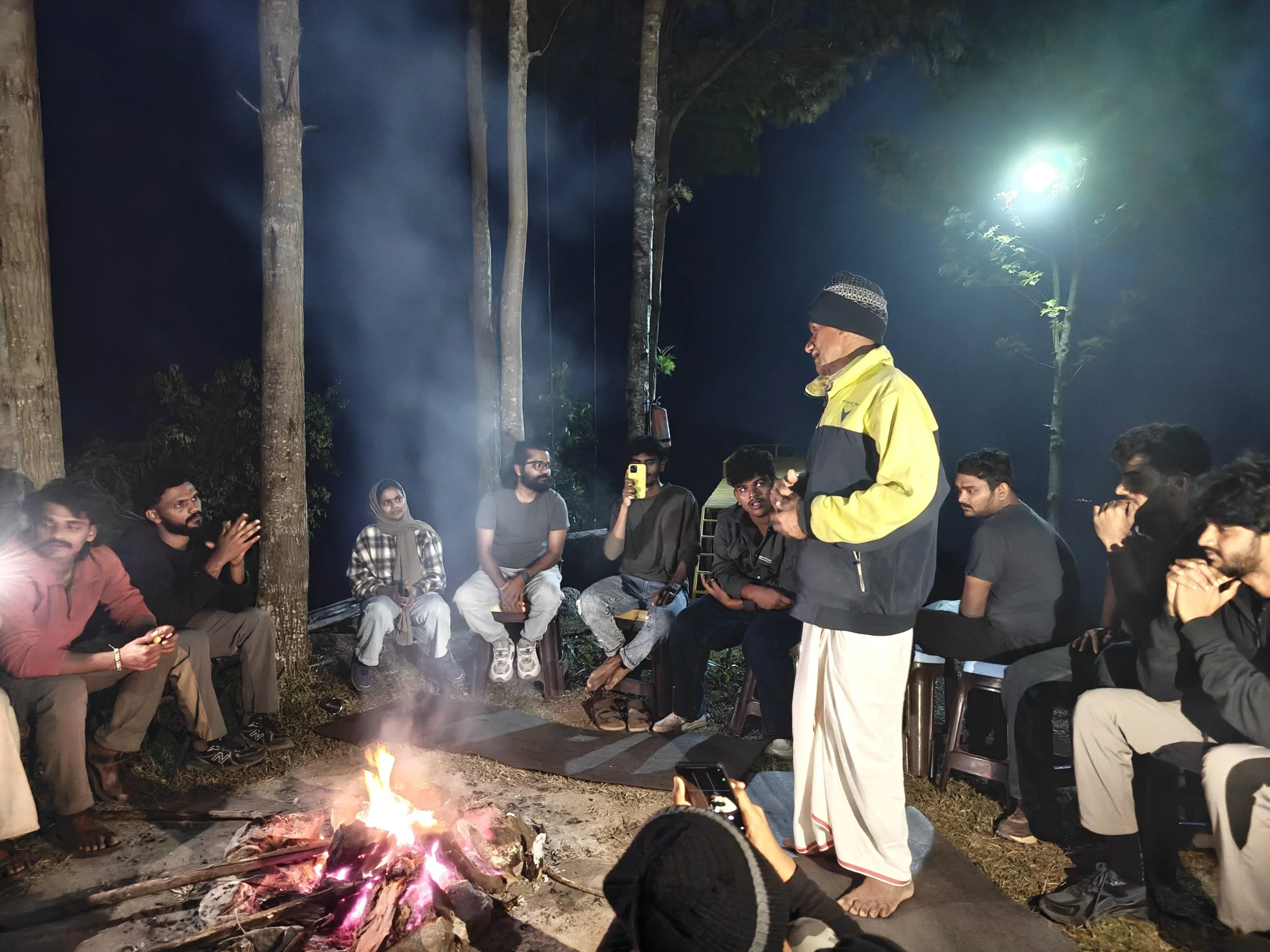
As darkness slowly wrapped the village, Thiru.Vairavan, an elderly man at the campsite, set up the campfire. He asked all of us to sit together. Flames crackled. Faces glowed. Strangers became familiar.
We began by introducing ourselves. Then came laughter—games like “Speak in your language”, Antakshari, and sharing trekking memories from different parts of the country. Dinner followed—simple, warm, comforting.
Some trekkers stayed out in the cold to celebrate the New Year at midnight. But my wife and I chose something different.
We sat quietly, reflecting on our lives, our choices, and our plans ahead. We spoke about where we are, where we want to go, and how much nature has shaped who we are becoming. That night, surrounded by mist, moving clouds, and a starry sky—partially hidden but deeply felt—we didn’t feel the need for fireworks or countdowns.
We followed our routine. We slept around 10:30 pm.
That night in Vellagavi was simple. Cold air biting gently at the skin. Warm food filling tired bodies. Legs heavy with effort. Sleep deep and uninterrupted. Welcoming the New Year not loudly—but peacefully, wrapped in silence, gratitude, and the gentle blessings of Mother Nature.
And honestly, I couldn’t have imagined a better way to step into a new beginning.
Just one year quietly making way for another.
And that’s when I knew—I wanted 2025 to end with a nature story, written in sweat, silence, and gratitude. And I wanted 2026 to begin with nature’s blessings, not resolutions.
That night in Vellagavi, as the mist wrapped the village and the campfire slowly faded into embers, I knew the journey wasn’t done. The forest had tested our preparation, offered us shelter, and gently eased us into a new year—but the mountains still had more to say.
Ahead of us lay another trail. Another silence. A longer walk that would begin before dawn and take us from the sacred calm of Vellagavi toward the edges of Vattakanal, and eventually, back home.
We slept peacefully that night—not knowing exactly what the next day would bring, but trusting the path as we always do.
Because some journeys don’t end when the sun sets. They reveal their deeper lessons only when you start walking again.