Beginning the Year on Foot
When we reached Vellagavi the previous day, it wasn’t just our bodies that needed rest—it was our minds. We had walked through forests, steep gradients, and layers of history. We had listened to the silence of a sacred village, shared stories around a campfire, and welcomed the new year in the quiet company of the mountains.
That night taught us something important: preparation brings confidence, but reflection brings clarity.
Day two would ask something different of us. Not just strength, but awareness. Not just movement, but intent. As dawn slowly touched the hills of Vellagavi, we packed our bags once again—ready to walk toward Vattakanal, carrying forward everything the first day had already taught us.
The trail awaited.
And so did the lessons.
Vellagavi to Vattakanal: Walking Forward with What the Mountains Taught Us
The day didn’t begin with an alarm. It began with light slowly finding its way through the mist.
When I stepped out of the tent in Vellagavi, the village was still asleep. Clouds moved gently between houses, hills appeared and disappeared, and the air carried a silence that felt deliberate—as if the mountains wanted us to listen before we walked again.
I stood there for a while, breathing deeply, letting the body wake up on its own terms. I told my wife softly, “Day one tested our preparation. Day two will test our awareness.”
As usual, I was the first one to wake up—and yes, I’m quietly proud of that habit. There’s something deeply satisfying about greeting the day before it fully arrives. I slipped out of the tent gently, careful not to disturb my partner who was still wrapped in peaceful sleep, and zipped it back quietly behind me.
The moment my feet touched the ground, I felt it—the cold. The grass, the soil, the air—everything carried a sharp, refreshing chill. For someone from Chennai, anything below 25°C already feels like an expedition into winter 😄. But here, it wasn’t just cold—it was alive.
I walked slowly, mindfully, without a destination. No phone. No thoughts to chase.
It felt like having a quiet conversation with Mother Nature, without words. I listened—to the breeze brushing past the trees, to birds calling out to the morning, to the subtle sounds that only exist when humans are still asleep. I watched clouds drift lazily across the valleys, sometimes revealing the land below, sometimes hiding it completely. The chill in the air, the silence, the movement—it all came together as one of those rare moments that stay with you for life.
I positioned myself to capture the sunrise, which was expected around 6:34 am. Slowly, I could see hints of golden light trying to break through. I waited patiently, eager to feel that first warm ray after a cold night.
And then—nature changed the script.
A thick set of clouds rolled in from the south, gently covering the eastern horizon. The land below disappeared into mist, and the sky turned completely overcast. The sunrise I was waiting for chose not to arrive the way I had imagined.
And strangely, I loved that too.
Because the mountains reminded me of something I deeply believe in:
Nature doesn’t perform on demand. It reveals what it wants, when it wants.
I smiled, packed away the camera, and stood there for a few more minutes—grateful not for what I saw, but for what I felt.
Because change is not a disappointment.
Change is the universe way of saying, “Stay present.”
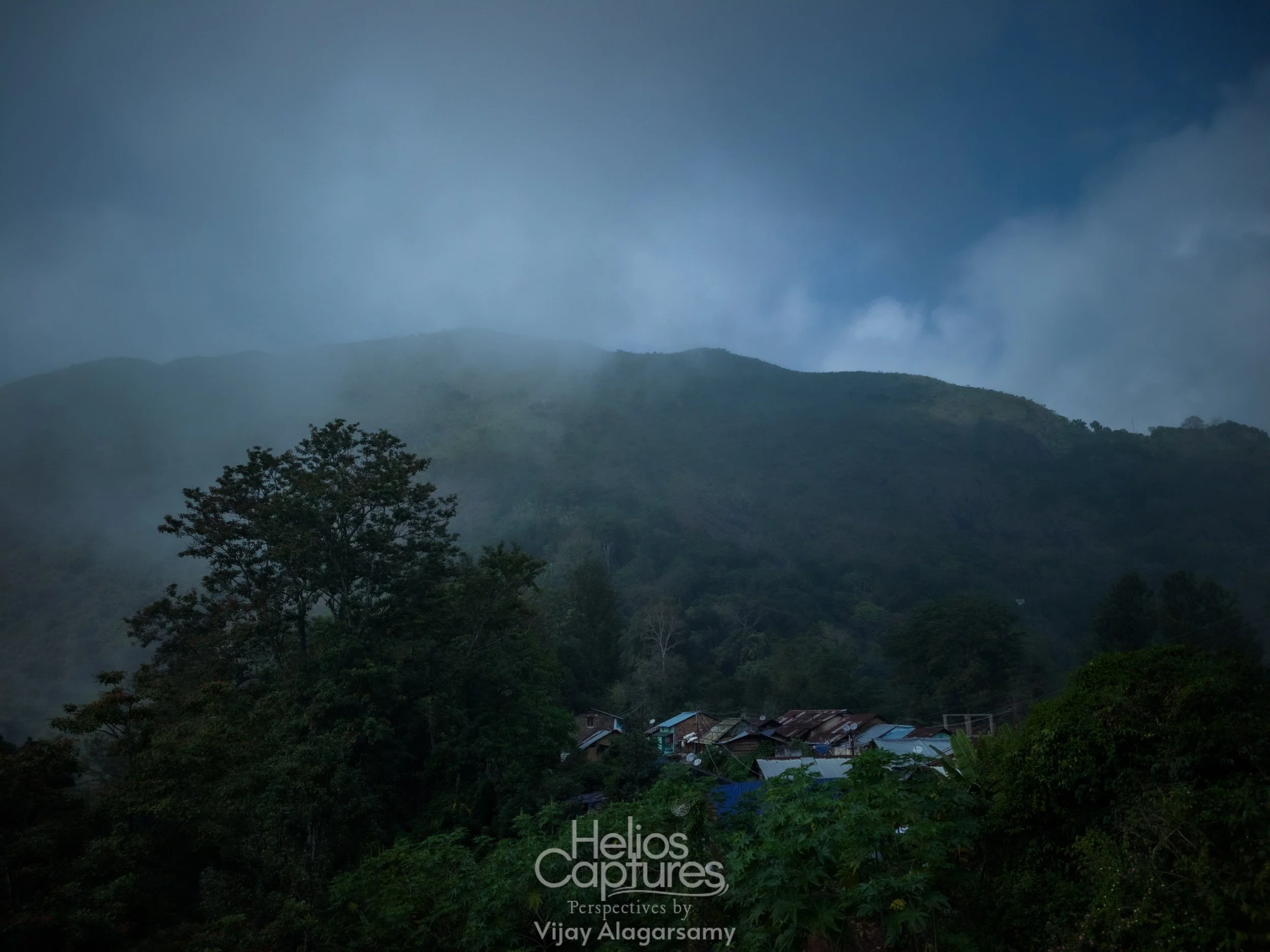
View of the sacred Vellagavi village
Starting Before the World Wakes Up
I went back to the tent with a heart full of warmth and welcomed her into the day—quietly, gently, the way mornings in the mountains deserve. There was no rush, no words needed at first. I held her hand, and together we stepped out to greet the morning.
We walked slowly around the campsite, hand in hand, letting the chill air wake us up and the scenery settle into our senses. The village was still calm. Clouds continued to drift lazily across the hills. The land felt soft, unhurried, and generous.
We had a simple black coffee and sat together, sipping it slowly. Conversations flowed easily—not about plans or distances, but about life, gratitude, and how good it felt to be exactly where we were. Moments like these don’t need excitement. They need presence.
Before the camp fully stirred awake, we took a few photographs around the campsite—not to capture memories obsessively, but to honour the moment. Some scenes deserve to be remembered, even if only as gentle reminders of how quietly beautiful life can be.
That was how Day-2 truly began—not with movement, but with connection.
We packed our bags slowly, without hurry. There was no urge to chase distance today.
The trail from Vellagavi Village to Vattakanal would be slightly shorter than Day-1, but we knew it would ask more of us. The gradient was expected to be at least 50% steeper, the path more open, and the challenge more mental than physical. Day one had tested our preparation. Day two would test our composure.
As we stepped out of the village, we walked barefoot until the boundary, as tradition demands. That simple act slowed me down instantly. It reminded me—once again—that this was not just a place we passed through. It was a space that deserved reverence.
Vellagavi hadn’t merely hosted us for a night. It had grounded us.
As we reached the edge of the village, I instinctively began wearing my shoes, leaning casually against a nearby compound wall—without realising it was part of a temple structure. A young villager approached me gently and, with a quiet smile, asked me to move away.
There was no anger. No correction. Just dignity.
I immediately stepped aside, feeling a wave of awareness wash over me. That moment stayed with me—not as embarrassment, but as a reminder: sacred spaces don’t announce themselves loudly. They expect us to be attentive.
Once we crossed the village boundary, footwear went back on, and the forest slowly reclaimed us.
My wife and I began walking toward Vattakanal. I turned back one last time and looked at the village—stone houses, temples, silence, faith. With a slightly heavy heart, I said to myself, “I will come back—before this year ends.”
Some places don’t feel like destinations. They feel like promises.
And Vellagavi had become one.
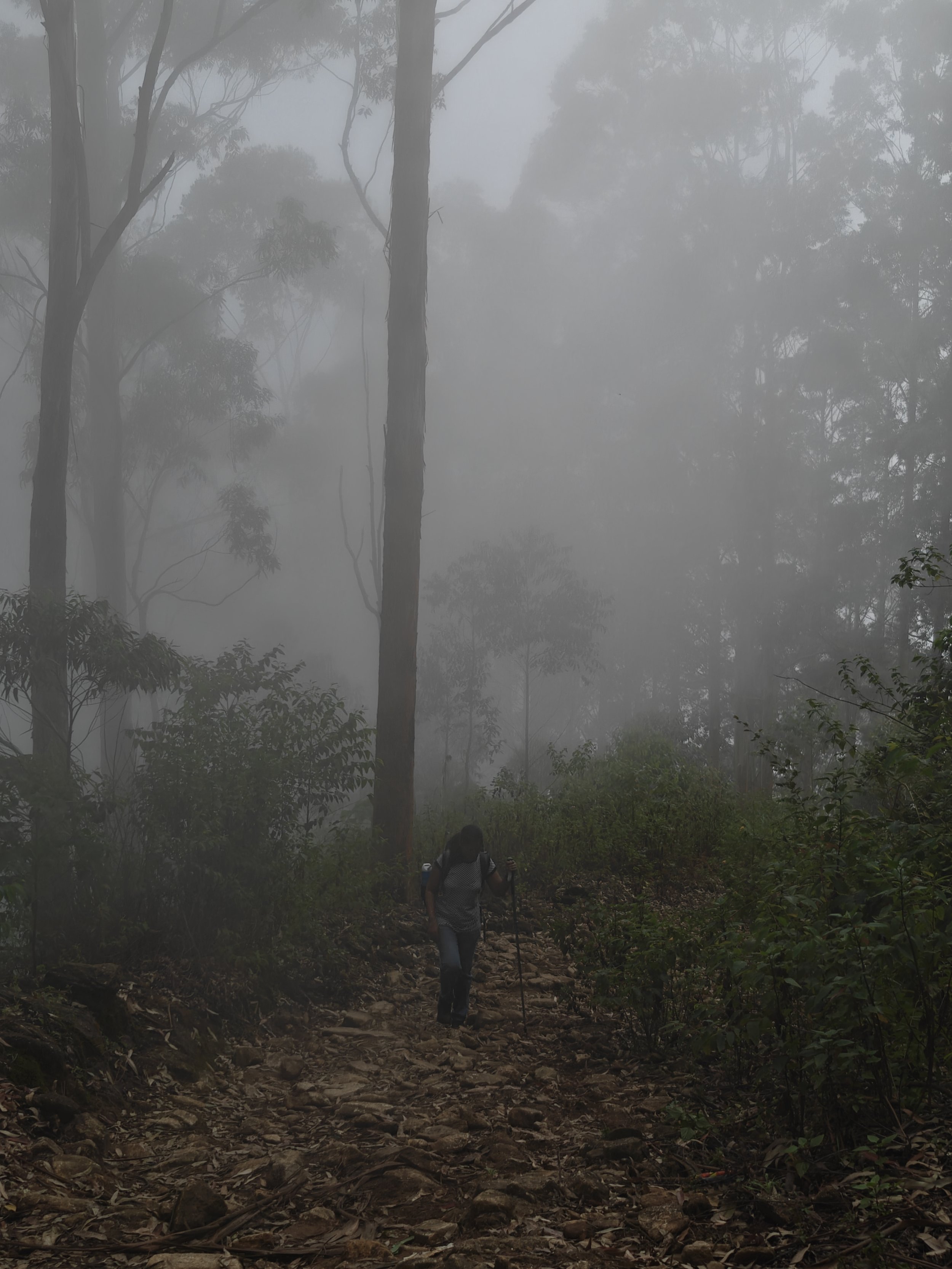
When Confidence Replaces Doubt
Something had clearly shifted from the previous day. Her steps were steadier, even as the trail pitched upward sooner and more sharply than before. Her breathing was calmer, despite the gradients demanding attention right from the start. And the questions—the quiet ones that used to surface before tough climbs—were gone.
This is something I’ve observed many times: when preparation meets real terrain, confidence doesn’t announce itself—it settles in. I didn’t need to reassure her today. I simply walked beside her, matching pace, matching breath.
All along the way, I stayed quietly attentive. I carried nutritious food, protein bars, and electrolytes, offering them not at every request, but only after she crossed a minimum checkpoint of about 750 metres each time. Not as denial—but as training. I told her gently, “Let the body work first. Support it after.”
At one particularly steep section, I reminded her softly, “Let the breath lead. The body will follow.” She nodded—no hesitation, no need for words.
As the trail opened up, the valley revealed itself below us, wide and exposed. The gradients were undeniably steeper than Day One, more open, more honest. But they no longer felt intimidating. Day one had already taught us how to respect steep climbs without fearing them.
Today wasn’t about proving strength. It was about trusting it.
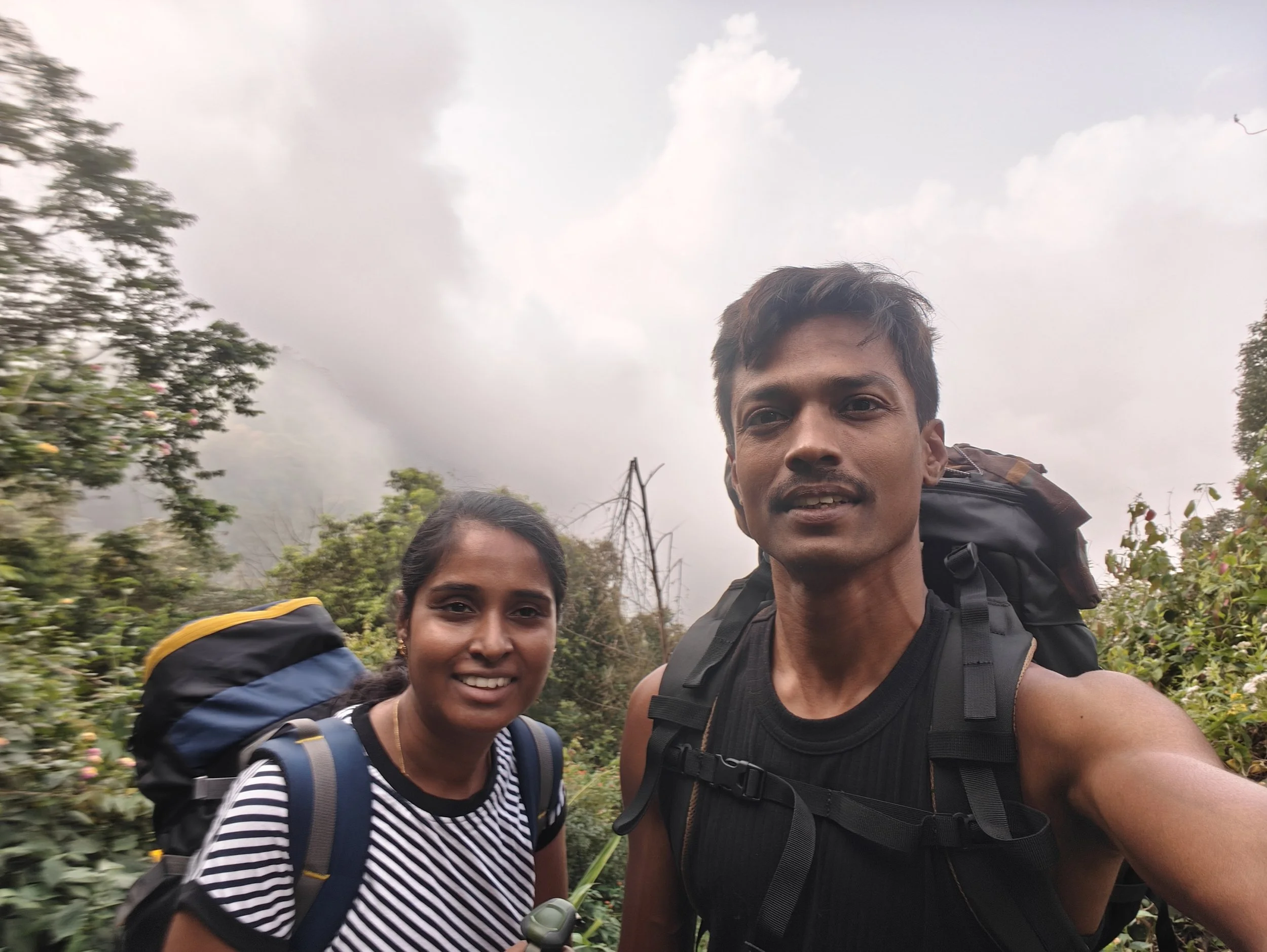
A Different Kind of Forest: Where Silence Widens and Awareness Sharpens
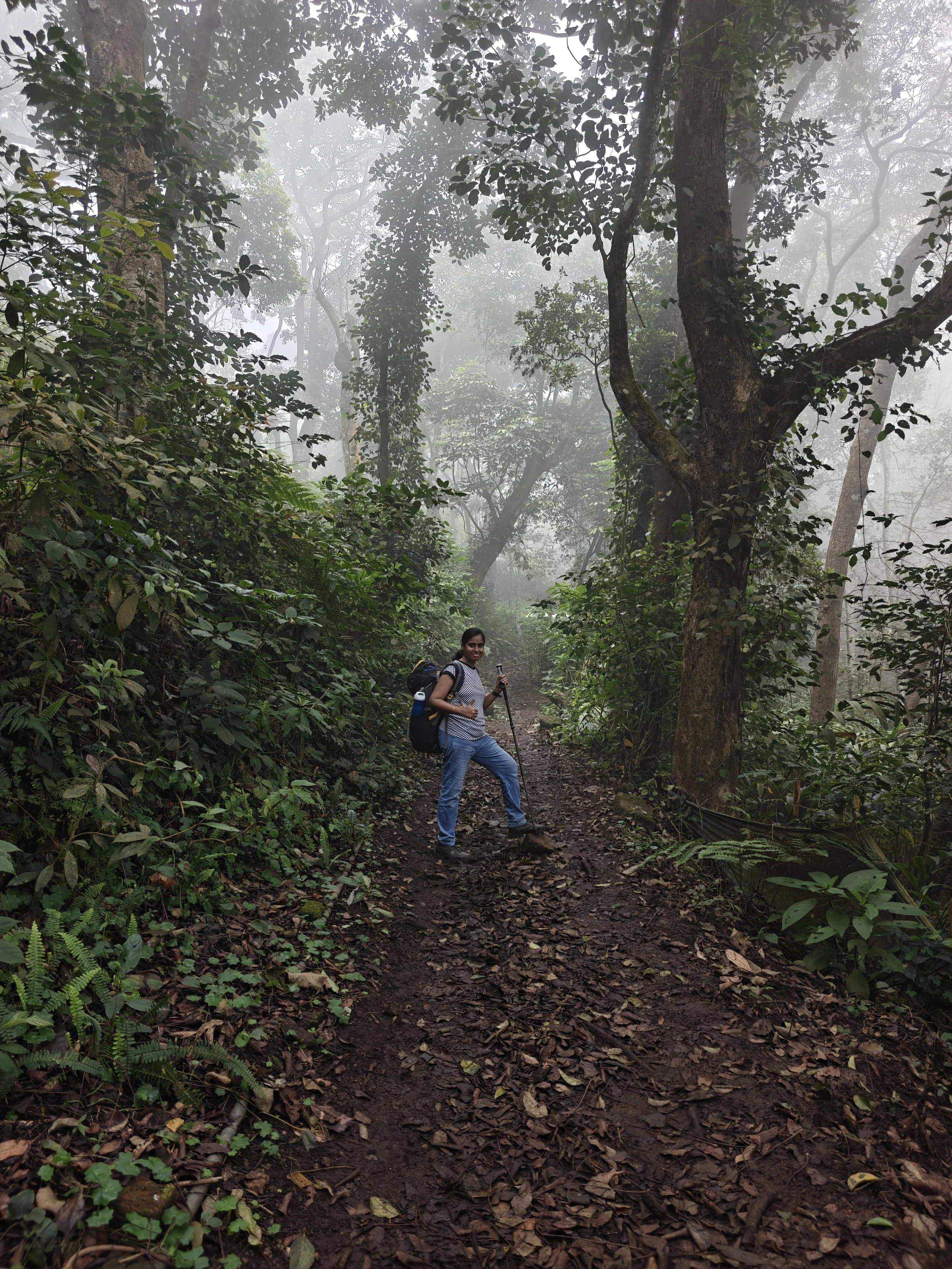
The forest between Vellagavi and Vattakanal feels different. Less enclosed. More expansive. And yet, at times, more uncertain.
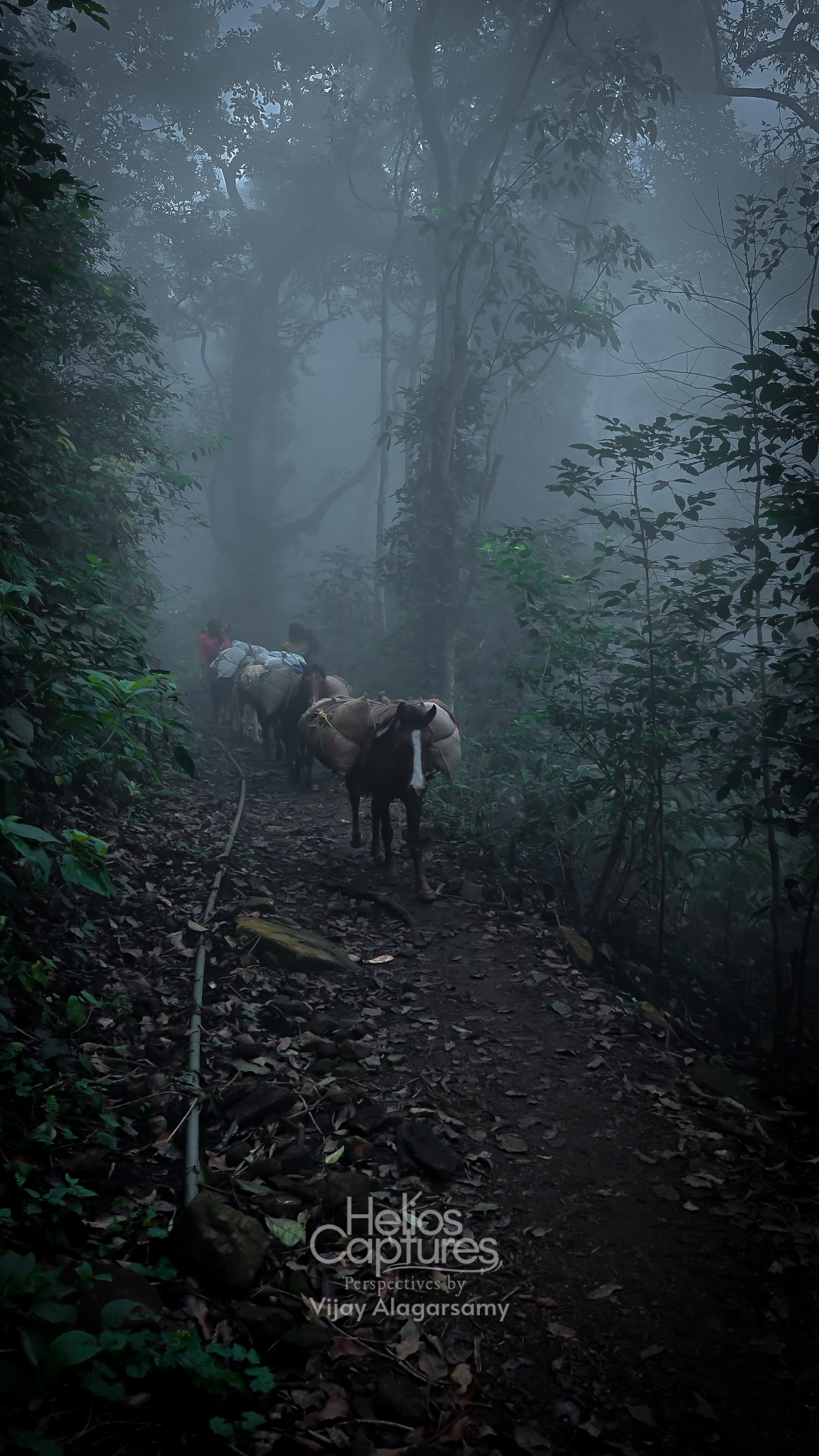
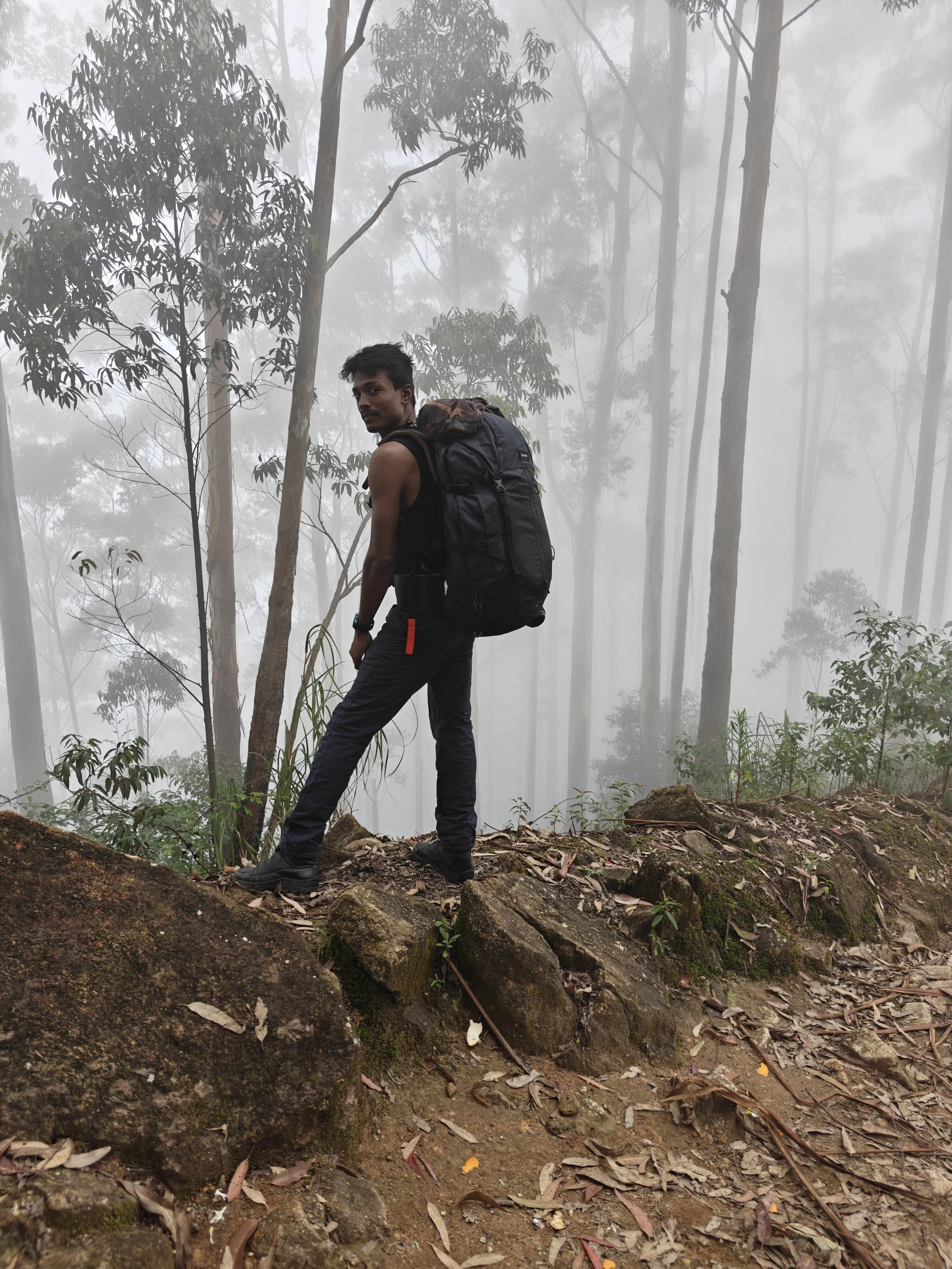
The silence here isn’t heavy—it’s spacious, stretched wide across open slopes and drifting clouds. Mist moved freely around us, sometimes revealing the trail, sometimes erasing it completely. Hills appeared and disappeared without warning, as if the landscape itself was breathing.
We walked through long sections without speaking. Not because we were tired, but because silence had become the most natural language. In those quiet stretches, I observed her closely—the way she adjusted her pace instinctively, slowed down without being told, paused when the body asked for it. Effort had softened into awareness.
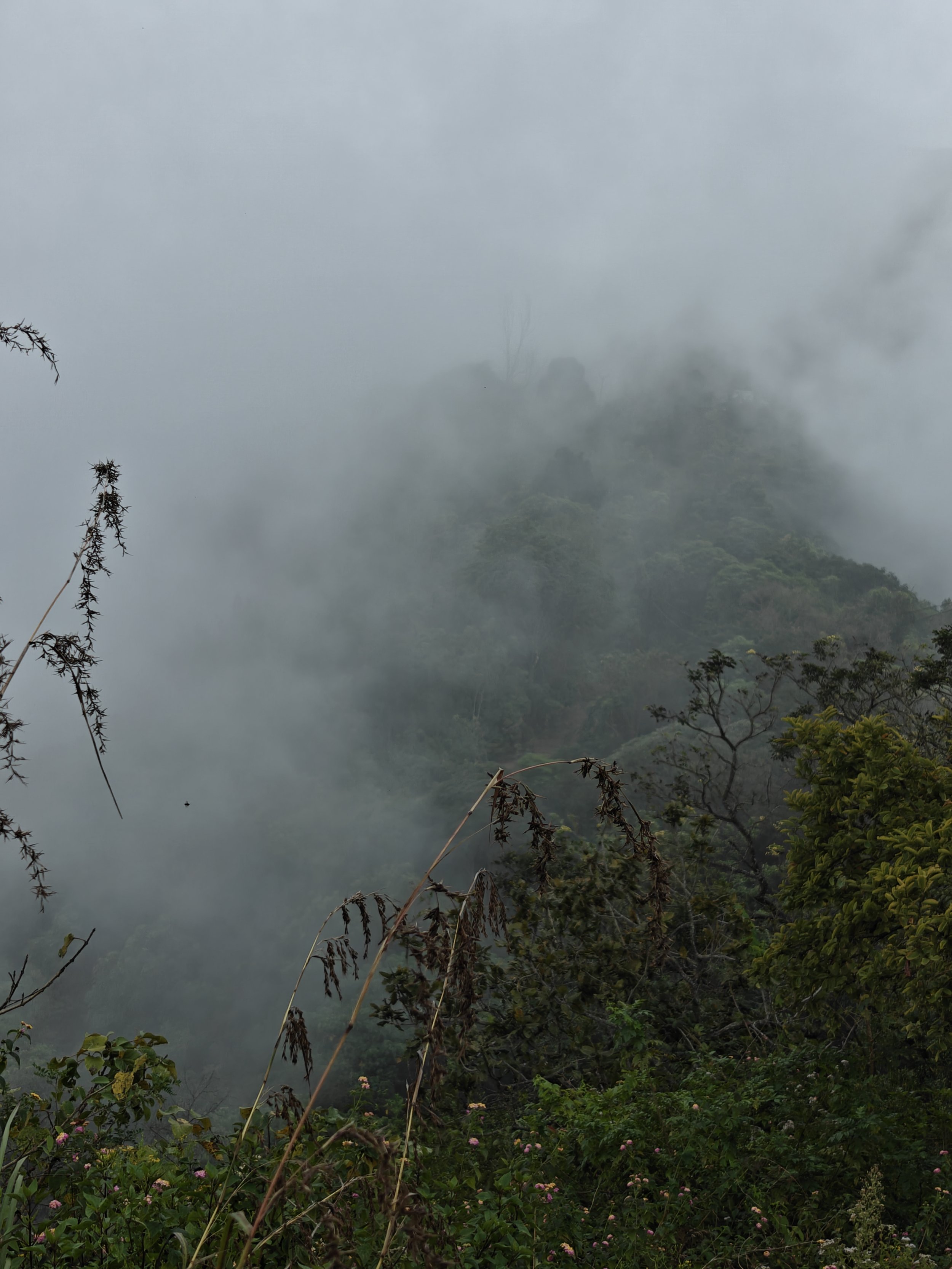
At one point, the visibility dropped drastically. Thick fog settled in, reducing the trail to just a few feet ahead. The path narrowed, the terrain turned unpredictable—loose, rolling rocks underfoot, uneven ground that demanded full attention. We slowed down almost instinctively, placing each step carefully, not rushing, not guessing.
I told her softly, “This is mental strength—knowing when to push, and knowing when not to.”
That’s something Tai Chi has taught me over the years. Not every movement needs force. Some need alignment. In low visibility, speed becomes risk. Awareness becomes safety.
As we moved through that fog-filled stretch, the trail stopped being something to conquer. It became something to listen to. And step by step, quietly and confidently, we moved forward—guided not by what we could see, but by how present we chose to be.
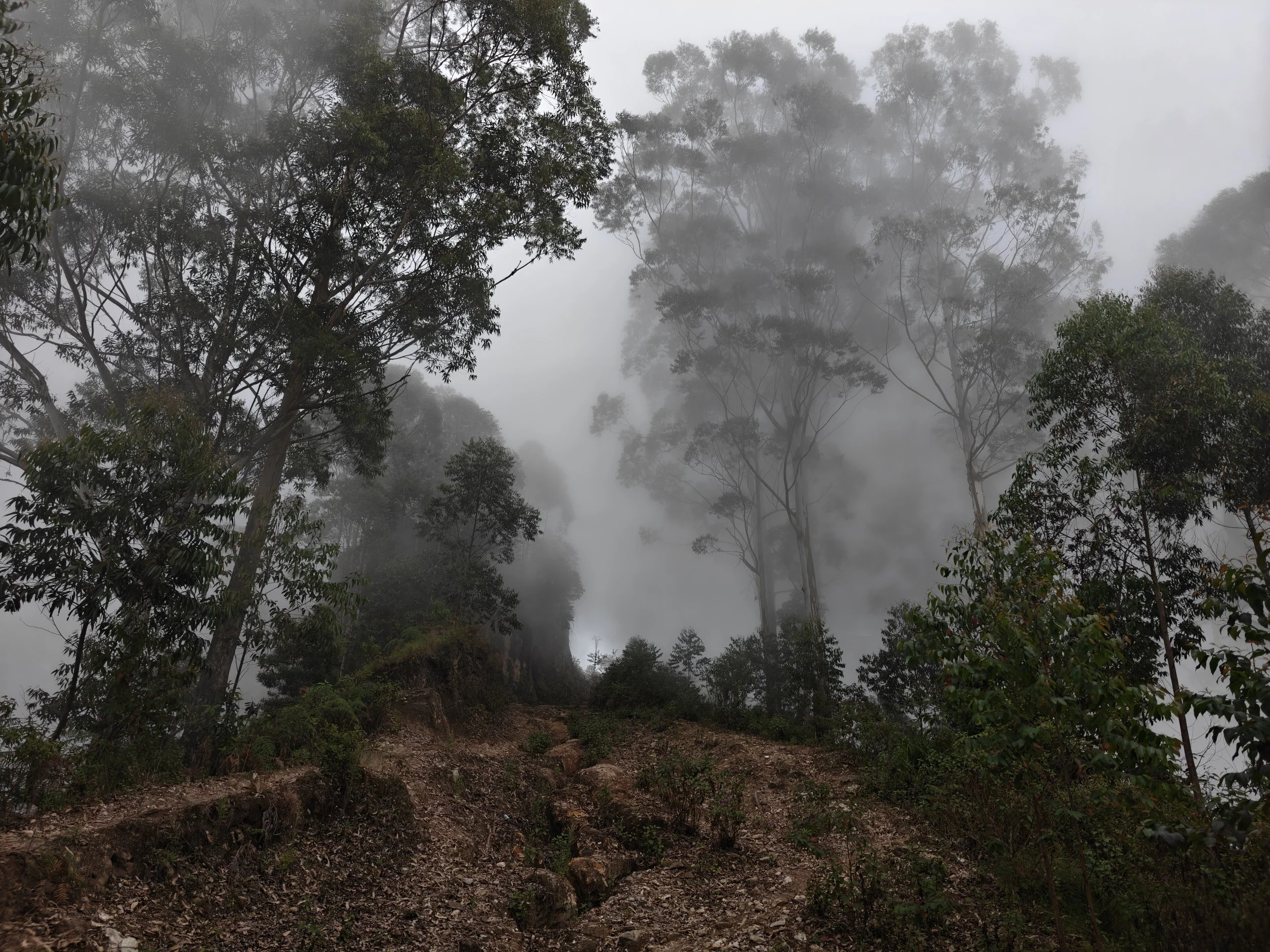
A view of one of the steepest segment!
Pauses That Matter
We took pauses—not because the body demanded them, but because the mind needed time to catch up with the beauty unfolding around us. Mist drifted slowly across distant hills, sometimes lifting just enough to reveal their contours before settling again. Birds cut through the quiet with sudden, fleeting calls. The wind moved through the treetops gently, as if reminding us to breathe.
I’ve always believed that a trek isn’t measured by distance alone, but by how often you can pause without impatience—how willingly you allow the moment to exist without trying to move past it.
During one such pause, as we stood quietly and let the fog thin and thicken around us, I looked at her and realised something important.
This trail was no longer testing her. It wasn’t asking questions. It wasn’t demanding proof.
It had become a conversation—a quiet exchange between effort and awareness, between confidence and calm. And she was listening, responding, and moving forward with ease.
In that moment, I knew the mountains weren’t just being crossed. They were being understood.
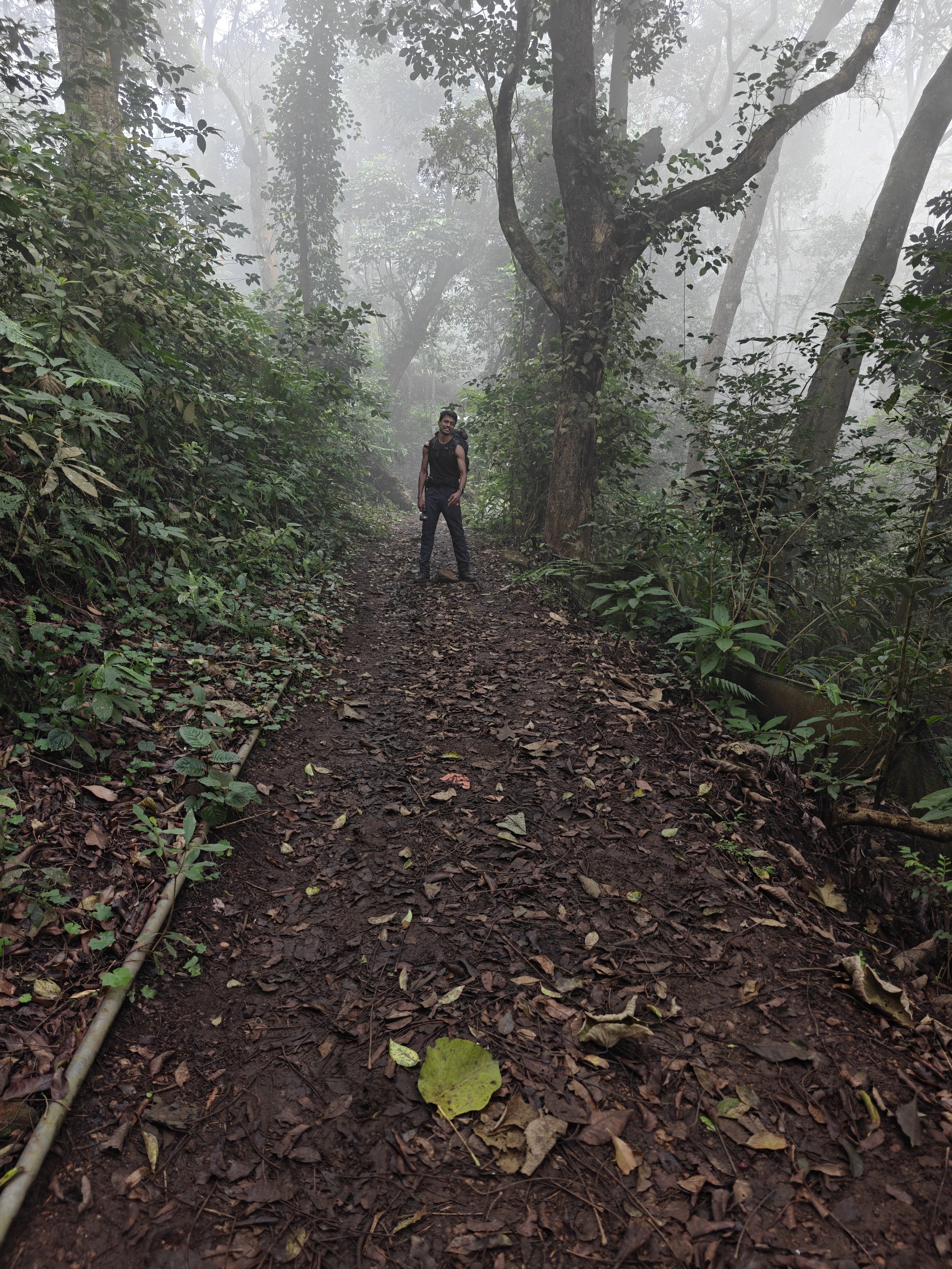
Entering Vattakanal
As we neared Vattakanal, the signs of habitation began to return—slowly at first, then unmistakably. Faint sounds. Distant voices. Subtle clearings. The forest didn’t end abruptly; it eased us back, almost respectfully, as if handing us over to civilisation after walking with us for so long.
Just before the forest department check post, with about 1.5 kilometres still to go, the fatigue finally surfaced. My wife asked me—more than five times—“How many kilometres more?”
I smiled. Not because it was funny, but because it was honest. This wasn’t doubt anymore. This was the body acknowledging effort.
Soon after, we reached Dolphin Nose. Standing there, looking out into the vastness below, we felt it—that quiet sense of achievement. Not celebration. Not relief. Just a deep breath that said, “We’ve come far.”
But the mountains weren’t done yet.
From Dolphin Nose to Vattakanal—just about 800 metres—came the real test. The gradient here was brutally steep, almost vertical in sections. At one point, I found myself smiling—not out of ease, but out of awe—as we literally walked over the slope using thick, ancient tree roots for support, roots that had probably been holding this soil together for decades. It felt raw, primal, and deeply grounding.
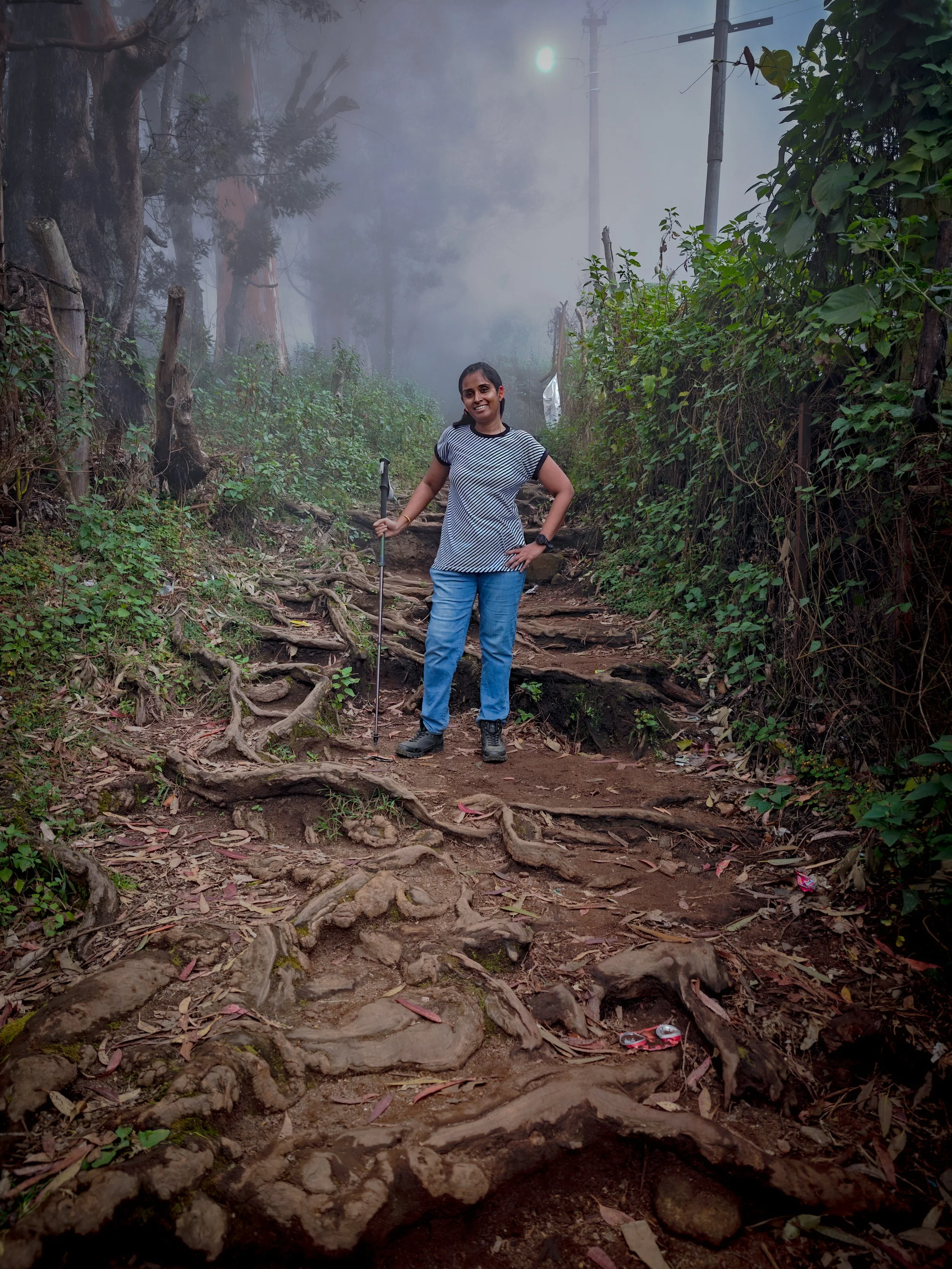
My queen conquering the roots!
That last stretch demanded everything.
Because the climb was so steep, I chose not to stop. I knew that once the body cooled down, restarting would be harder. So I kept moving—slow, continuous, focused—letting breath and momentum carry me upward.
When I finally reached the top, the transition was immediate and jarring.
Roads. Vehicles. Voices. Tourists. Honks. Chaos.
We were back in the civilised world—and the contrast hit me hard. The silence we had walked through for two days dissolved instantly into noise and urgency. I turned back to look for her, but I couldn’t see her yet emerging from the trail.
I ordered a bread omelette and a cup of tea and waited—watching, listening, sensing the sudden shift in energy. From that vantage point, I could already see dense traffic, a clear sign of New Year crowds flooding Kodaikanal.
Instinctively, I spoke to the tea shop owner and asked if he knew any taxi service. Without hesitation, he smiled and said he’d help. He called a friend—someone who ran a taxi—and assured me he’d come to pick us up and drop us safely into Kodaikanal.
Standing there, tea in hand, waiting for her to arrive at the top, I realised something quietly but clearly:
Reaching Vattakanal didn’t feel like an achievement. It felt like a completion.
When she finally came up, tired but steady, I told her, “See how different this feels from yesterday? Same body. Same terrain. Different mindset.”
She smiled. That was enough.
Walking Back Home
From there, our journey slowly shifted—from trail to road, from silence to sound, from forest rhythm to human pace. The change was immediate and unmistakable. And yet, something stayed with us, steady and unshaken.
She finished her bread omelette quietly, and almost perfectly timed, the taxi arrived. We got in and began moving toward the Kodaikanal bus stand, watching the hills slowly slip behind us through the window. The body was tired, but the mind was calm—the kind of calm that only comes after effort has been honoured.
One special thing about this journey was that we travelled entirely by public transport. No rush, no shortcuts—just moving with the flow of everyday life. Our return home meant changing multiple buses, allowing the journey to continue even after the trek had ended.
At Vathalakundu bus stand, we stopped for tea. As we stood there sipping it slowly, a government bus conductor struck up a conversation with us. He asked about the trek—where we had walked, how it felt. We exchanged New Year wishes, smiles, and stories.
There was something deeply uplifting about his energy—warm, genuine, full of life. Before we realised it, he quietly paid for our tea and snacks. No reason. No expectation. Just kindness.
We took a few photos with him, thanked him sincerely, and moved on—carrying that moment with us as carefully as we carried memories of the mountains.
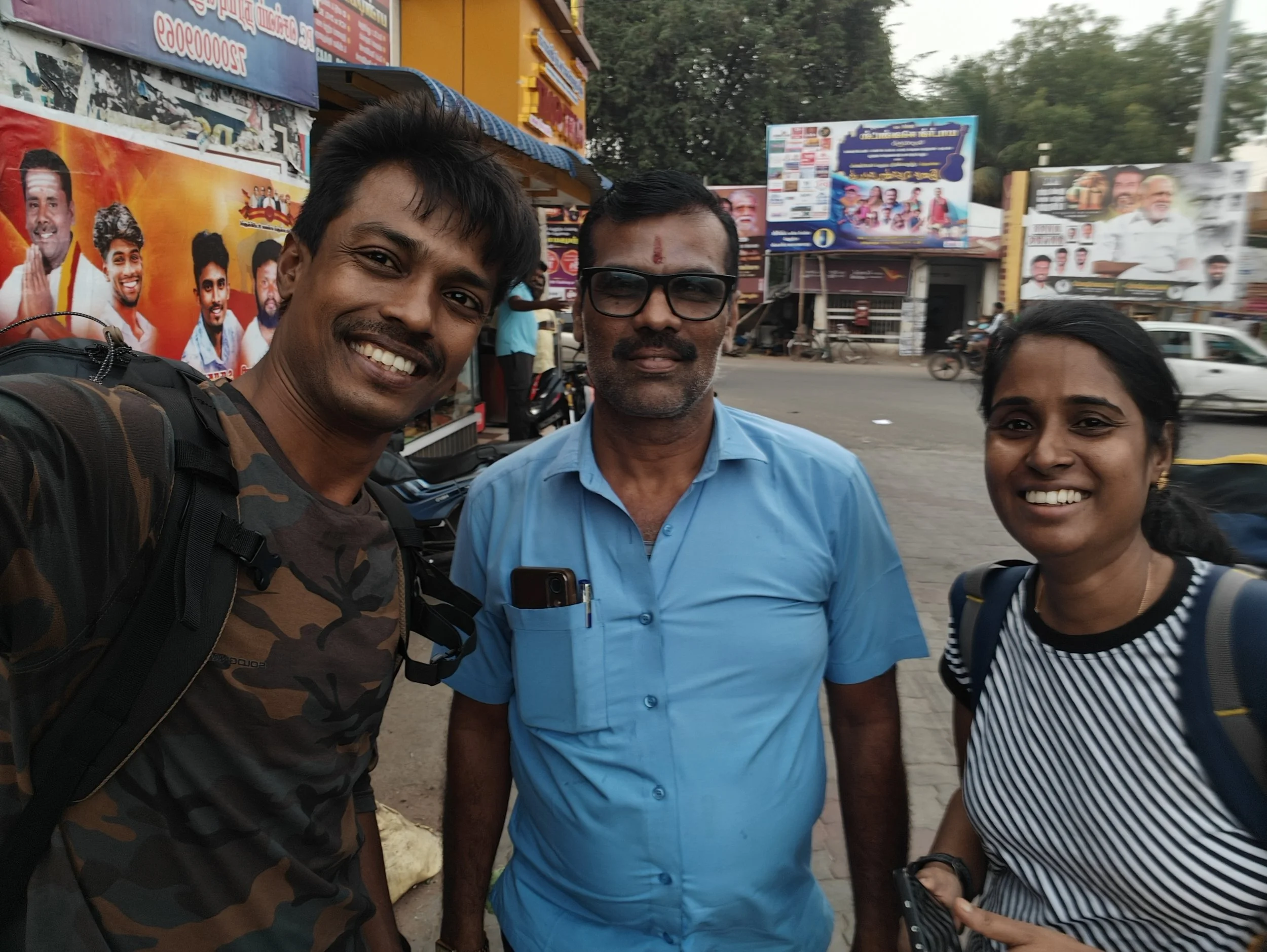
Happiness with a stranger friend!
By the time we finally headed back home, we knew we weren’t just returning with tired legs.
We were carrying back:
the calm of Vellagavi mornings
the confidence built step by step
the quiet trust that preparation always shows up when needed
and the reminder that kindness, like nature, often appears when you least expect it
As the bus rolled forward, I reflected on how perfectly this journey had unfolded—not because everything went as planned, but because everything arrived when it was meant to.
The trail had ended. But the journey, in every meaningful way, continued.
What Day Two Left Us With
Day one taught us humility—how to slow down, how to listen, how to respect what lies ahead. Day two taught us flow—how to move without resistance, how to trust preparation, how to stay present even when the path steepens.
Together, they reminded me why I walk the way I do. Why I train consistently, not for milestones but for reliability. Why I believe nature is the greatest teacher—if you’re willing to listen without trying to control the lesson.
This wasn’t just a trek from Vellagavi to Vattakanal. It was the continuation of a learning that began long before we packed our bags—and one that will quietly shape us long after we unpack them.
We didn’t rush back home. We didn’t feel the need to announce anything. We returned aligned—body settled, mind clear, heart grounded.
And as always, the mountains didn’t say goodbye. They never do.
They simply stayed—silent, patient—waiting for the next time we choose to walk with them again.
What the Mountains Gave Me Back
This journey reminded me—quietly and clearly—why I live the way I do. Why I train consistently, even when there’s no immediate goal in sight. Why Tai Chi is non-negotiable in my life—not as exercise, but as a way of moving through the world. And why the wilderness remains my greatest teacher—patient, honest, and uncompromising.
Nature doesn’t reward ego. It doesn’t respond to force or hurry. It rewards sincerity—the kind that shows up prepared, listens deeply, and adapts without complaint.
We didn’t just trek from Kumbakarai to Kodaikanal via Vellagavi. We closed a year with humility. We opened a new one with gratitude.
And we carried forward a quiet promise—to walk through life the same way we walked these mountains: prepared in the body, balanced in the mind, patient in effort, and deeply present in every step.
If you’ve read this far, I hope you didn’t just read a story. I hope—if only for a moment—you walked beside us.
Heard the forest breathe.
Felt the cold air settle at sunset.
Watched clouds rise from below your feet.
Because once you experience that kind of presence, the mountains never really let you leave.